Catalog
This catalog lists every species from German folklore and mythology available
for simulation in stdgrimmsim — 32 species and 150 demographic models.
Each has made-up but population-genetically plausible genomes and demographic
histories tied to geographic regions (Black Forest, Harz, Rhine, Bavaria,
Prussia, Saxony, etc.) and to Grimm fairy tales where relevant.
For a compact list of all 150 models with links into this page, see All demographic models (also in the sidebar).
Demography schematic diagrams (one per model) are shown below when available.
To generate them, run from the repo root: python docs/generate_demography_figures.py
(requires demesdraw; install with uv sync --extra docs).
Which chromosome (
Genomeobject)?Which model of demographic history (
DemographicModelobject)?
Example: simulate mountain dwarf samples under the Black Forest demographic model:
$ stdgrimmsim ZweBerg -d BlackForest_1D12 -o dwarves.trees -L 100000 BlackForest:10
Fairy tale & Grimm
Mountain Dwarves (Zwergus bergensis) — Bergzwerge from Grimm and regional folklore, associated with mines and forests (e.g. Snow White’s dwarves, Harz and Schwarzwald).
Genome summary
- ID:
ZweBerg- Species:
Zwergus bergensis
- Common name:
Bergzwerg (Mountain Dwarf)
- Assembly:
Schneewittchen1.0(GCA_GRIM_000001)- Ploidy:
2
- Generation time:
25 years
- Population size:
80,000
Chromosomes
Name |
Length (bp) |
Mutation rate |
Recombination rate |
|---|---|---|---|
1 |
22,000,000 |
2.50e-08 |
2.50e-08 |
2 |
20,000,000 |
2.50e-08 |
2.50e-08 |
3 |
18,000,000 |
2.50e-08 |
2.50e-08 |
4 |
16,000,000 |
2.50e-08 |
2.50e-08 |
5 |
14,000,000 |
2.50e-08 |
2.50e-08 |
mountain_mitogenome |
17,000 |
7.00e-08 |
0.00e+00 |
Demographic models
BlackForest_1D12
Single population Schwarzwald dwarf model
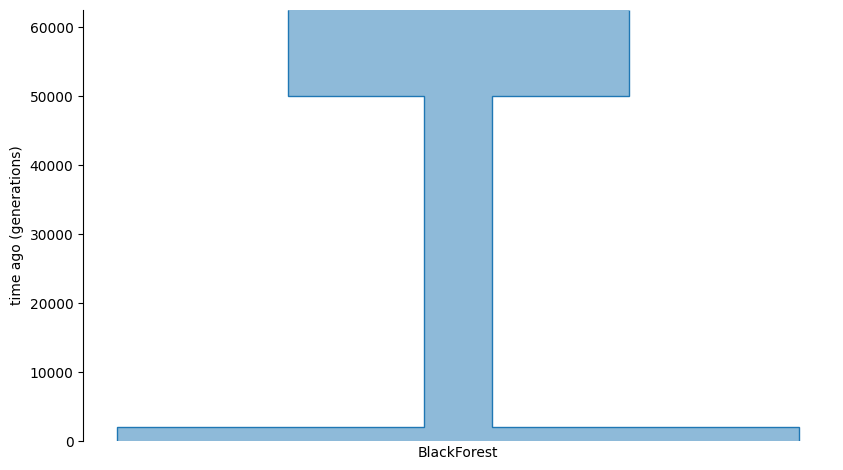
Populations: BlackForest
Single population of mountain dwarves in the Black Forest. Three epochs: modern (N=80000), bottleneck 2000 gen ago (N=8000), ancestral founding 50000 gen ago (N=40000).
HarzBlackForest_2D12
Two population Harz and Schwarzwald dwarf model
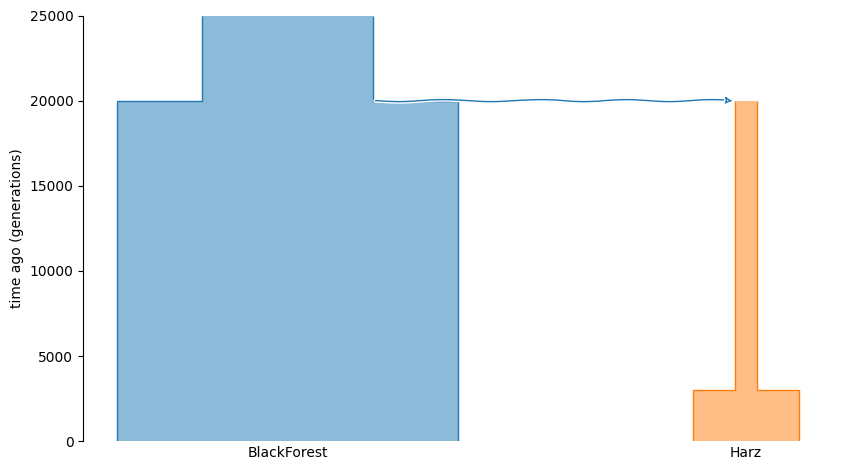
Populations: BlackForest, Harz
Two populations: Black Forest core and Harz colony. Ancestral N=40000. Split 20000 gen ago. Schwarzwald at 80000, Harz bottleneck to 5000 then growth to 25000.
AlpineDwarfRadiation_3D12
Three population Alpine dwarf radiation model
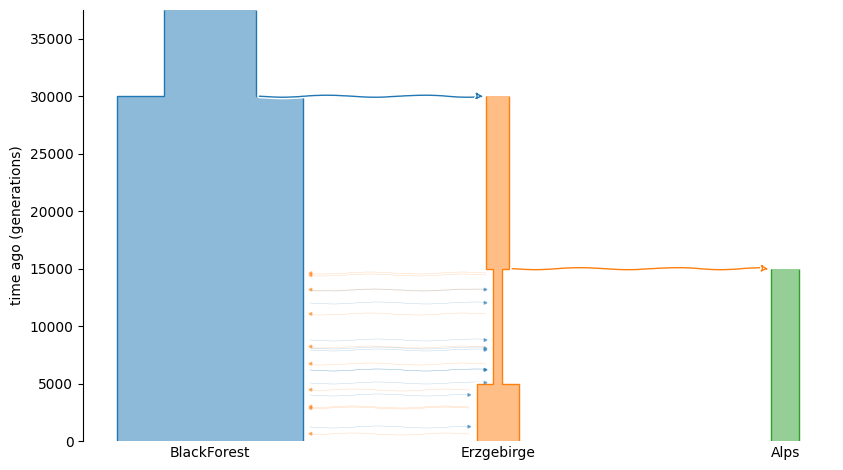
Populations: BlackForest, Erzgebirge, Alps
Three populations of mountain dwarves across central Europe. Ancestral population in the Black Forest (N=40000) splits 30000 gen ago into Schwarzwald and proto-Eastern dwarves. Eastern branch splits 15000 gen ago into Erzgebirge and Alps colonies. Schwarzwald grows to 80000, Erzgebirge bottleneck to 4000 then recovery to 18000, Alps steady at 12000. Low migration between Schwarzwald and Erzgebirge (1e-5 per gen) after split.
MineCollapse_1D12
Single population with multiple bottlenecks from mine collapses
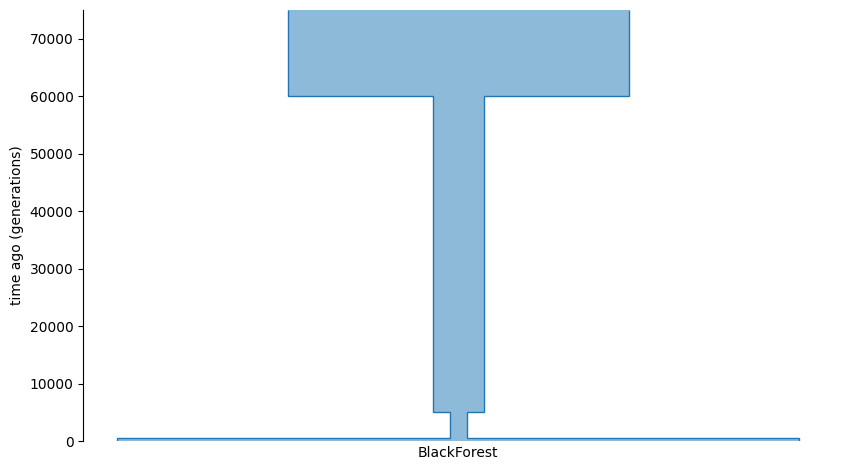
Populations: BlackForest
Single population of mountain dwarves with multiple bottleneck events. Modern N=80000, severe mine collapse bottleneck 500 gen ago (N=2000), recovery period, older iron age disruption bottleneck 5000 gen ago (N=6000), ancestral founding 60000 gen ago (N=40000).
IsolationMigration_2D12
Classic IM model between BlackForest and Harz with asymmetric migration
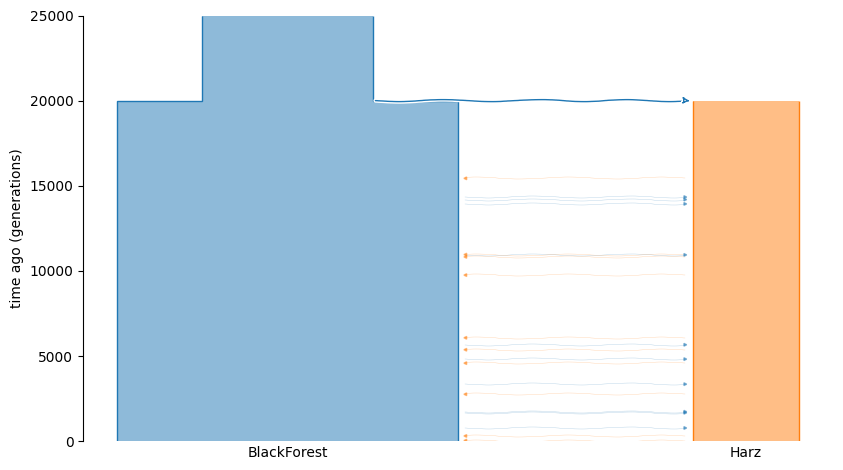
Populations: BlackForest, Harz
Isolation-with-migration model between Black Forest and Harz dwarves. BlackForest N=80000, Harz N=25000. Split 20000 gen ago from ancestral N=40000. Asymmetric migration: BF->Harz 2e-5, Harz->BF 5e-6.
FourMountainRanges_4D12
Four population stepping-stone model across mountain ranges
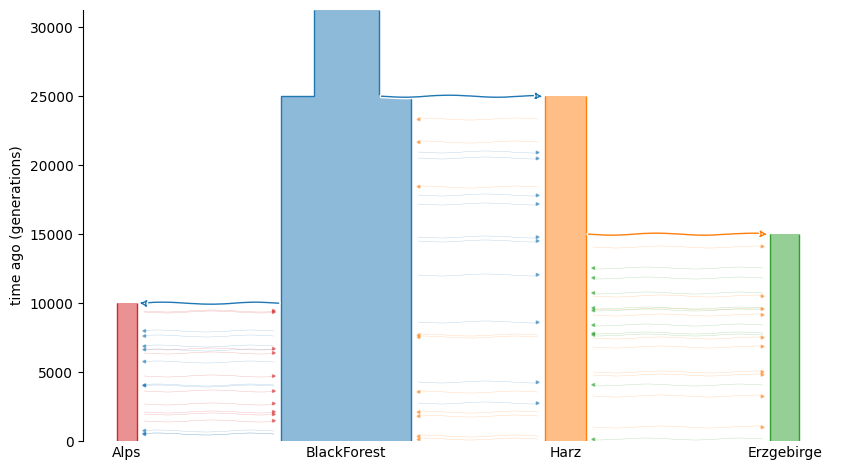
Populations: BlackForest, Harz, Erzgebirge, Alps
Four populations of mountain dwarves: BlackForest, Harz, Erzgebirge, and Alps. Ancestral N=40000. Harz splits from BlackForest 25000 gen ago. Erzgebirge splits from Harz 15000 gen ago. Alps split from BlackForest 10000 gen ago. Modern sizes: BF 80000, Harz 25000, Erzgebirge 18000, Alps 12000. Stepping-stone migration between adjacent ranges: BF-Harz 5e-6, Harz-Erz 8e-6, BF-Alps 3e-6.
PostGlacialExpansion_1D12
Single population exponential growth model post-glacial expansion
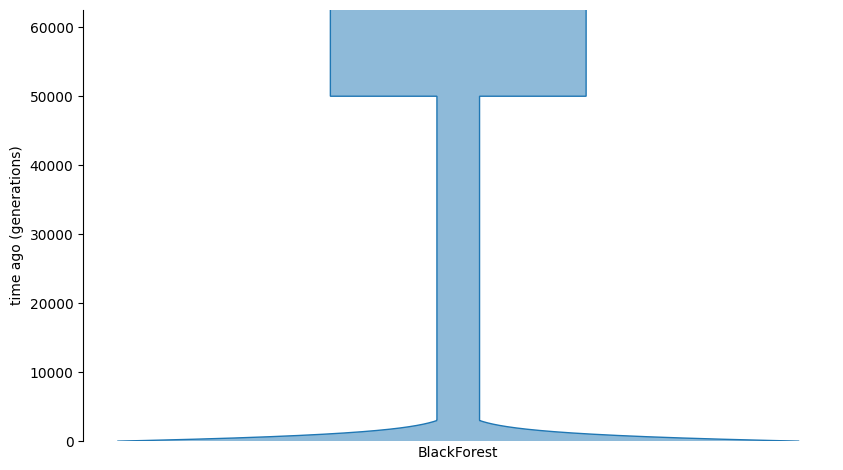
Populations: BlackForest
Single population of mountain dwarves with post-glacial exponential expansion. Modern N=80000 growing exponentially from N=5000 starting 3000 gen ago. Before that, stable at 5000 back to 50000 gen ago where ancestral N=30000.
Frau Holle (Holle hesseensis) — The fairy-tale figure from Grimm KHM 24, associated with the well, snow, and the realm beyond (Hesse/Thuringia).
Genome summary
- ID:
FraHol- Species:
Holle hesseensis
- Common name:
Frau Holle (fairy-tale realm)
- Assembly:
FrauHolle1.0(GCA_GRIM_000004)- Ploidy:
2
- Generation time:
30 years
- Population size:
60,000
Chromosomes
Name |
Length (bp) |
Mutation rate |
Recombination rate |
|---|---|---|---|
1 |
26,000,000 |
2.50e-08 |
2.60e-08 |
2 |
23,000,000 |
2.50e-08 |
2.60e-08 |
3 |
20,000,000 |
2.50e-08 |
2.60e-08 |
4 |
18,000,000 |
2.50e-08 |
2.60e-08 |
5 |
16,000,000 |
2.50e-08 |
2.60e-08 |
well_mitogenome |
16,500 |
7.50e-08 |
0.00e+00 |
Demographic models
WellRealm_1D12
Single population Frau Holle realm model
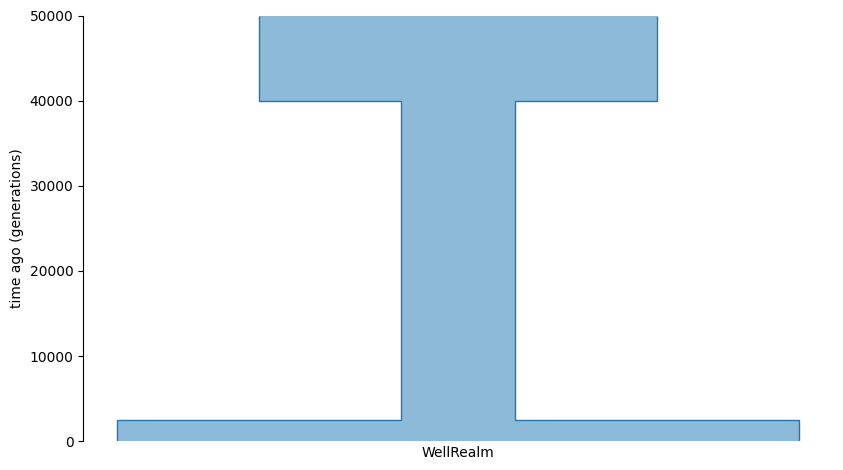
Populations: WellRealm
Single population in Frau Holle’s realm (Grimm KHM 24). Modern N=60000, bottleneck 2500 gen ago (N=10000), ancestral 40000 gen ago (N=35000).
WellSnow_2D12
Two population Well and Snow realm model
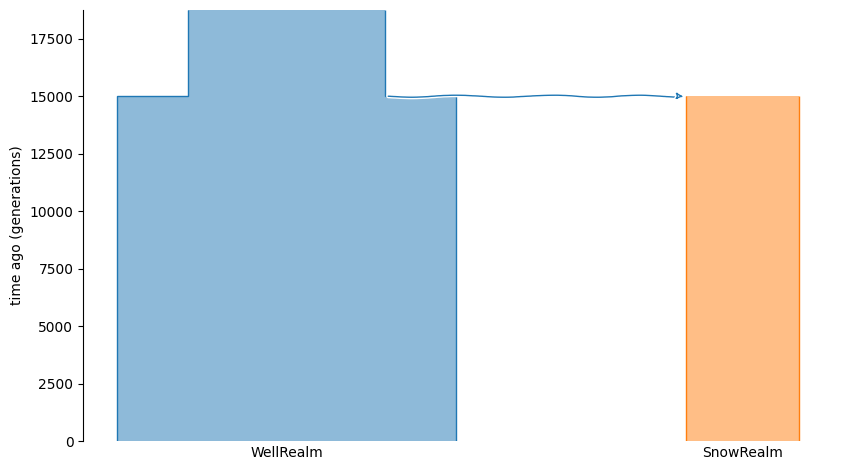
Populations: WellRealm, SnowRealm
Well realm and Snow realm. Ancestral N=35000. Split 15000 gen ago. Well 60000, Snow 20000.
ThreeRealms_3D12
Three realm Frau Holle demographic model
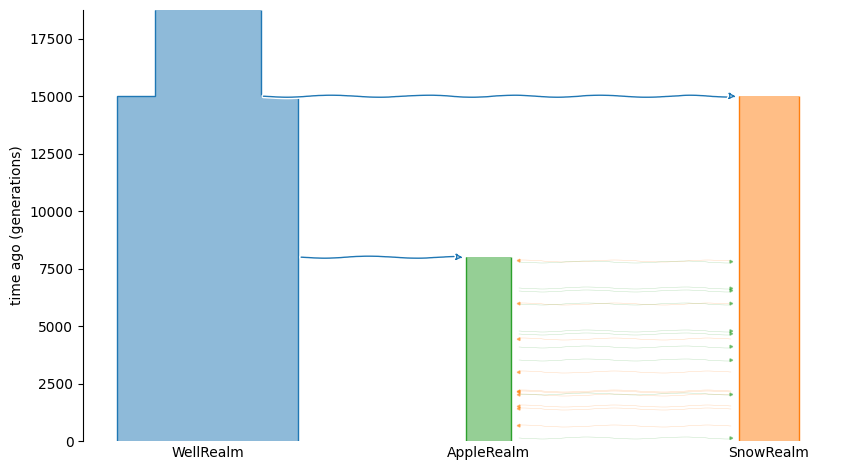
Populations: WellRealm, SnowRealm, AppleRealm
Three realms of Frau Holle (KHM 24): Well, Snow, and Apple. Ancestral realm N=35000. Well-Snow split 15000 gen ago. Apple realm branches from Well 8000 gen ago. Well at 60000, Snow at 20000, Apple at 15000. Seasonal migration between Snow and Apple (2e-5 per gen).
WellRealmExpansion_1D12
Single population with exponential growth in the Well Realm
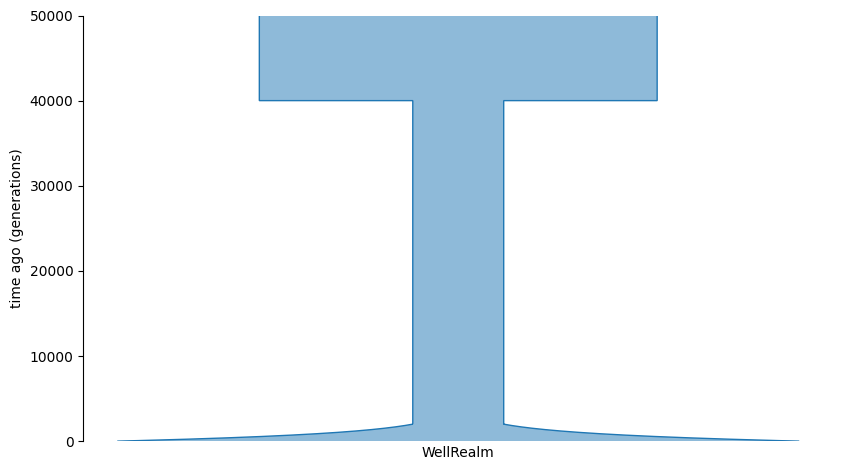
Populations: WellRealm
Single population in Frau Holle’s Well Realm with exponential expansion. Modern N=60000, exponential growth starting 2000 gen ago from N=8000. Ancestral stable at 35000 from 40000 gen ago.
WellSnowIM_2D12
IM model between Well and Snow realms with asymmetric migration
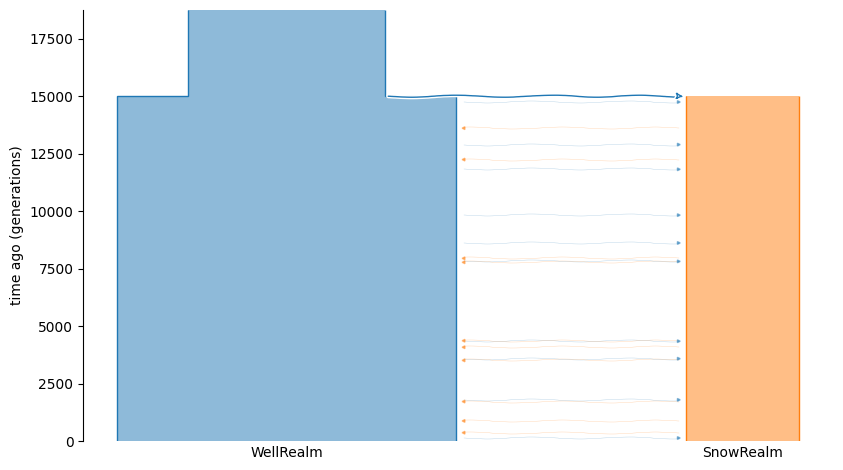
Populations: WellRealm, SnowRealm
Isolation-with-migration model between Well Realm and Snow Realm. Well N=60000, Snow N=20000. Split 15000 gen ago from ancestral N=35000. Asymmetric migration: Well->Snow 3e-5, Snow->Well 1e-5.
FourRealms_4D12
Four realm Frau Holle demographic model
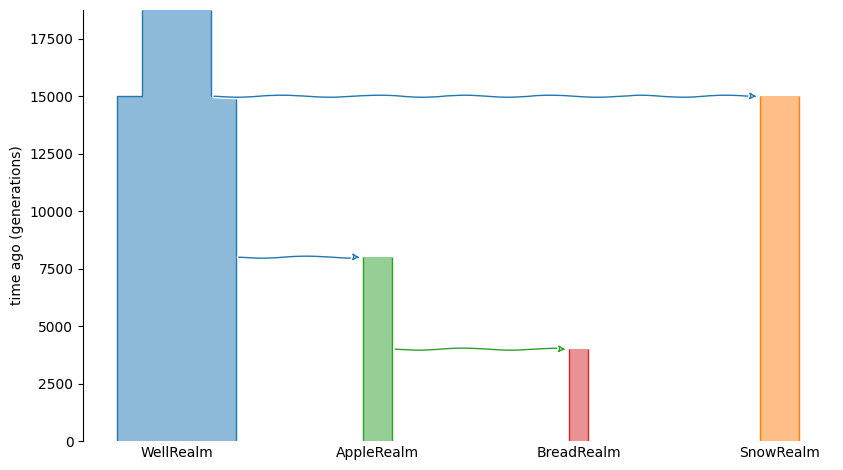
Populations: WellRealm, SnowRealm, AppleRealm, BreadRealm
Four realms of Frau Holle: Well, Snow, Apple, and Bread. Ancestral realm N=35000. Snow splits from Well 15000 gen ago. Apple splits from Well 8000 gen ago. Bread splits from Apple 4000 gen ago. Well 60000, Snow 20000, Apple 15000, Bread 10000.
GoldenAge_1D12
Single population with ancient golden age and bottleneck
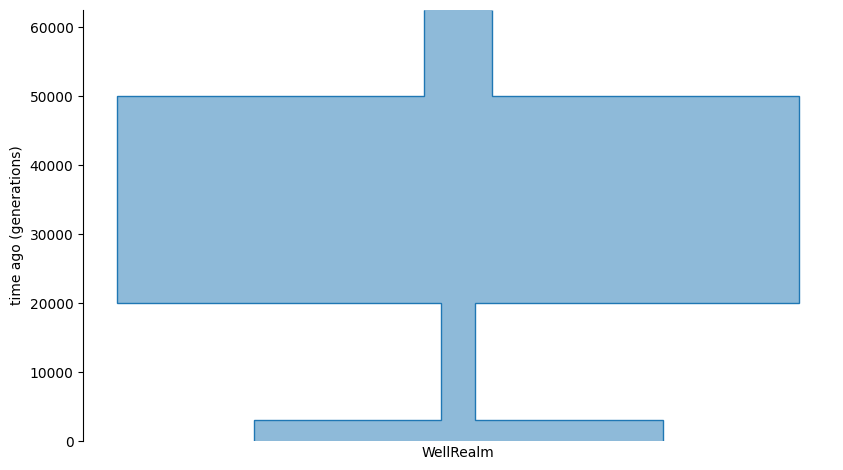
Populations: WellRealm
Single population in Frau Holle’s realm with an ancient golden age. Modern N=60000, bottleneck 3000 gen ago (N=5000), golden age from 20000-40000 gen ago (N=100000), founding 50000 gen ago (N=10000).
Heinzelmaennchen (Heinzelmaennchen coloniensis) — The helpful elves of Cologne who secretly did the townspeople’s work at night, until a tailor’s wife spied on them (Kopisch 1836).
Genome summary
- ID:
HeiCol- Species:
Heinzelmaennchen coloniensis
- Common name:
Heinzelmaennchen (Cologne elves)
- Assembly:
Heinzel1.0(GCA_GRIM_000013)- Ploidy:
2
- Generation time:
8 years
- Population size:
300,000
Chromosomes
Name |
Length (bp) |
Mutation rate |
Recombination rate |
|---|---|---|---|
1 |
12,000,000 |
3.00e-08 |
3.20e-08 |
2 |
10,000,000 |
3.00e-08 |
3.20e-08 |
3 |
9,000,000 |
3.00e-08 |
3.20e-08 |
4 |
8,000,000 |
3.00e-08 |
3.20e-08 |
workshop_mitogenome |
13,500 |
1.00e-07 |
0.00e+00 |
Demographic models
Cologne_1D12
Single population Cologne Heinzelmaennchen model
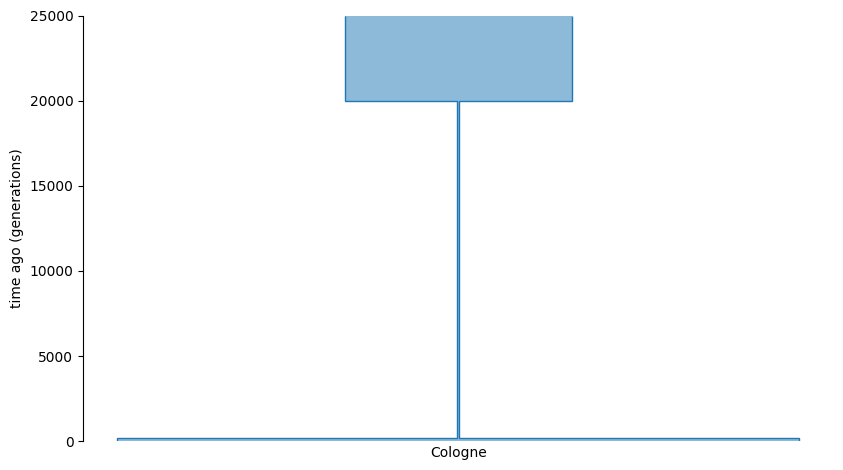
Populations: Cologne
Single population of Heinzelmaennchen in Cologne. Modern N=300000, catastrophic decline 200 gen ago (N=1000) when the tailor’s wife spied on them (Kopisch 1836), ancestral 20000 gen ago (N=100000).
CologneAachen_2D12
Two population Cologne-Aachen Heinzelmaennchen model
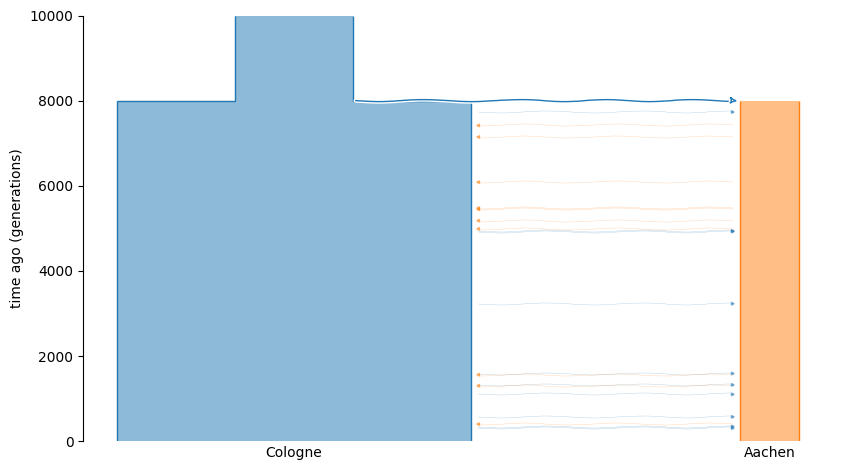
Populations: Cologne, Aachen
Cologne and Aachen Heinzelmaennchen. Ancestral N=100000. Split 8000 gen ago along Rhine trade routes. Cologne 300000, Aachen 50000. High migration (5e-5).
ThreeRhinelandCities_3D12
Three population Heinzelmaennchen model (Cologne, Aachen, Bremen)
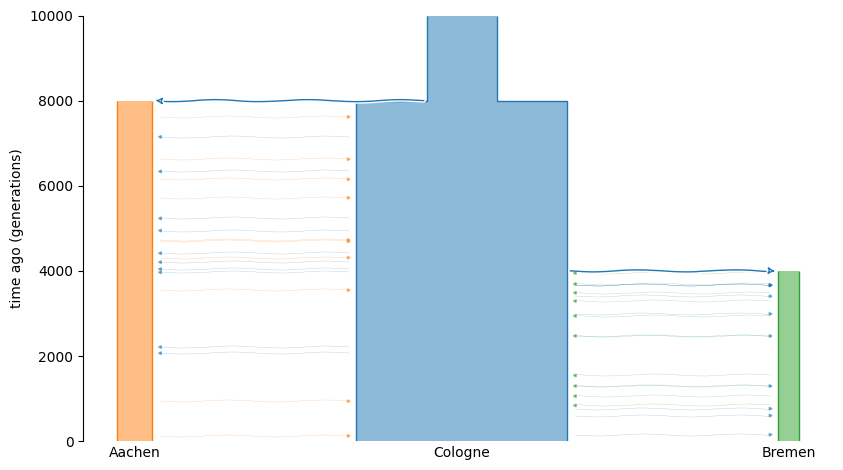
Populations: Cologne, Aachen, Bremen
Three city populations of helpful elves. Ancestral N=100000. Aachen splits from Cologne 8000 gen ago. Bremen colonized from Cologne 4000 gen ago. Cologne 300000, Aachen 50000, Bremen 30000. High migration Cologne-Aachen (5e-5), lower Cologne-Bremen (1e-5).
TailorsWifeBottleneck_1D12
Single population bottleneck from the tailor’s wife legend
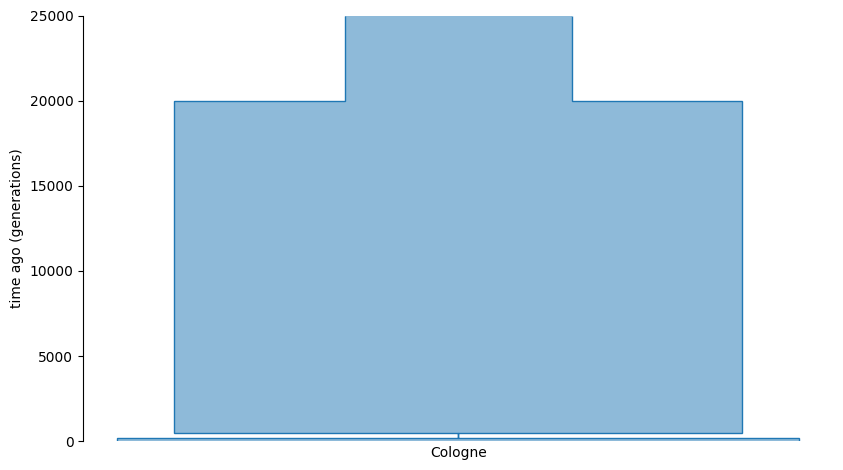
Populations: Cologne
Single population Heinzelmaennchen model with dramatic bottleneck. Modern N=300000. Catastrophic decline 200 gen ago (N=100) from the tailor’s wife peas-on-stairs incident. Pre-discovery 500 gen ago N=250000. Ancestral 20000 gen ago N=100000.
CologneAachenIM_2D12
Isolation-with-migration model for Cologne and Aachen
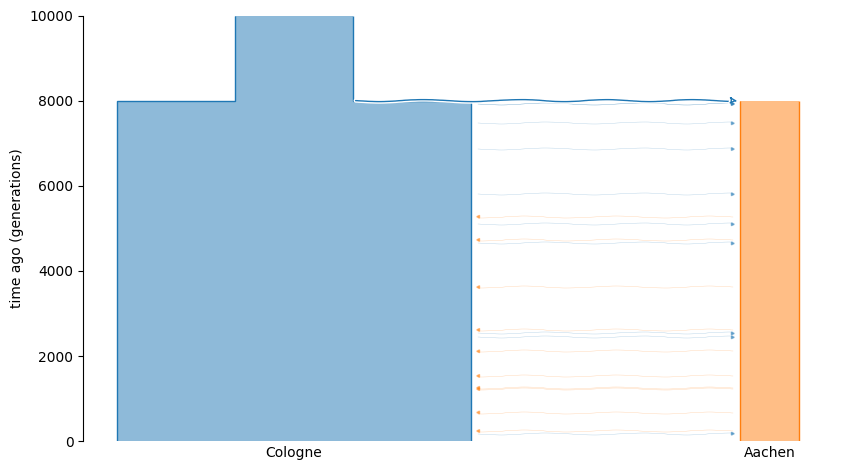
Populations: Cologne, Aachen
Isolation-with-migration model for Cologne and Aachen Heinzelmaennchen. Cologne 300000, Aachen 50000. Split 8000 gen ago from ancestral N=100000. Asymmetric migration: Cologne->Aachen 8e-5, Aachen->Cologne 2e-5.
FourRhinelandCities_4D12
Four population Heinzelmaennchen model (Cologne, Aachen, Bremen, Duesseldorf)
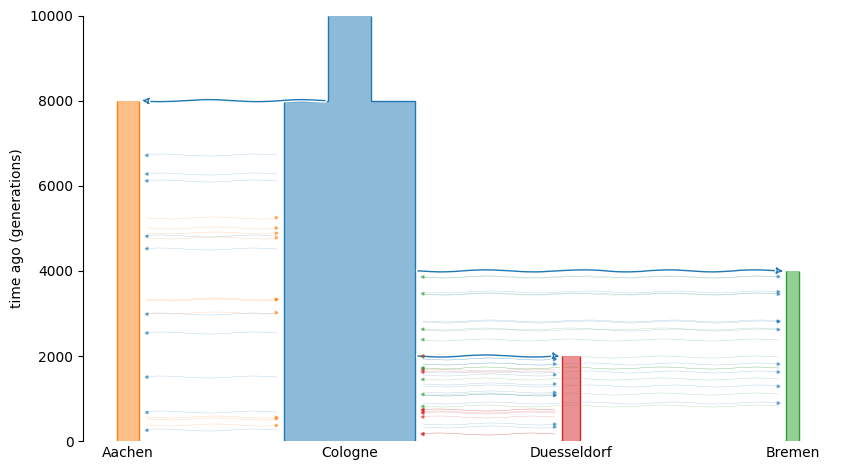
Populations: Cologne, Aachen, Bremen, Duesseldorf
Four city populations of Heinzelmaennchen. Ancestral N=100000. Aachen splits from Cologne 8000 gen ago. Bremen colonized from Cologne 4000 gen ago. Duesseldorf from Cologne 2000 gen ago. Cologne 300000, Aachen 50000, Bremen 30000, Duesseldorf 40000.
NocturnalWorkshop_1D12
Single population with night-shift population cycles
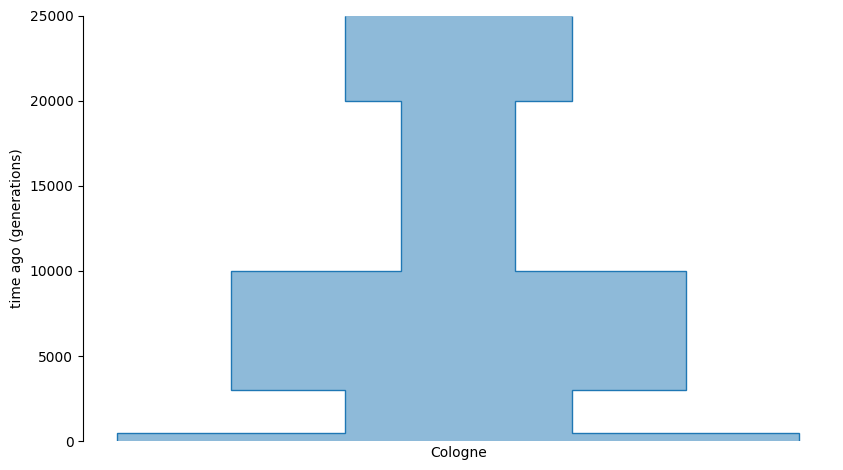
Populations: Cologne
Single population Heinzelmaennchen model with oscillating size reflecting nocturnal work cycles. Modern N=300000, 500 gen ago N=100000, 3000 gen ago N=200000, 10000 gen ago N=50000, 20000 gen ago N=100000.
CologneExpansion_1D12
Single population exponential growth model for Cologne
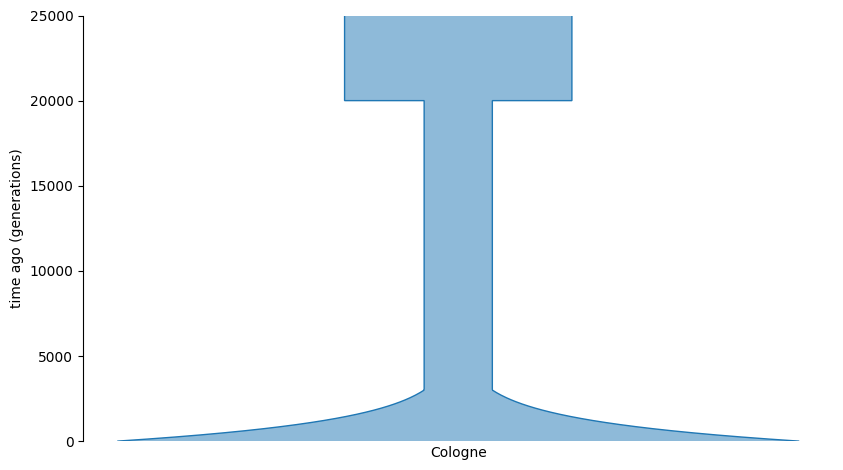
Populations: Cologne
Single population Heinzelmaennchen model with exponential growth. Modern N=300000, exponential growth from N=30000 starting 3000 gen ago. Before that stable at 30000 from 20000 gen ago at N=100000. growth_rate = ln(300000/30000)/3000 ~ 0.000768.
Kobold (Koboldus domesticus) — House spirits bound to hearth and home, ranging from helpful household helpers to mischievous mine spirits (Berggeist).
Genome summary
- ID:
KobHau- Species:
Koboldus domesticus
- Common name:
Kobold (house spirit)
- Assembly:
Kobold1.0(GCA_GRIM_000008)- Ploidy:
2
- Generation time:
15 years
- Population size:
200,000
Chromosomes
Name |
Length (bp) |
Mutation rate |
Recombination rate |
|---|---|---|---|
1 |
15,000,000 |
2.80e-08 |
3.00e-08 |
2 |
13,000,000 |
2.80e-08 |
3.00e-08 |
3 |
11,000,000 |
2.80e-08 |
3.00e-08 |
4 |
10,000,000 |
2.80e-08 |
3.00e-08 |
hearth_mitogenome |
14,500 |
9.00e-08 |
0.00e+00 |
Demographic models
UrbanKobold_1D12
Single population urban Kobold model
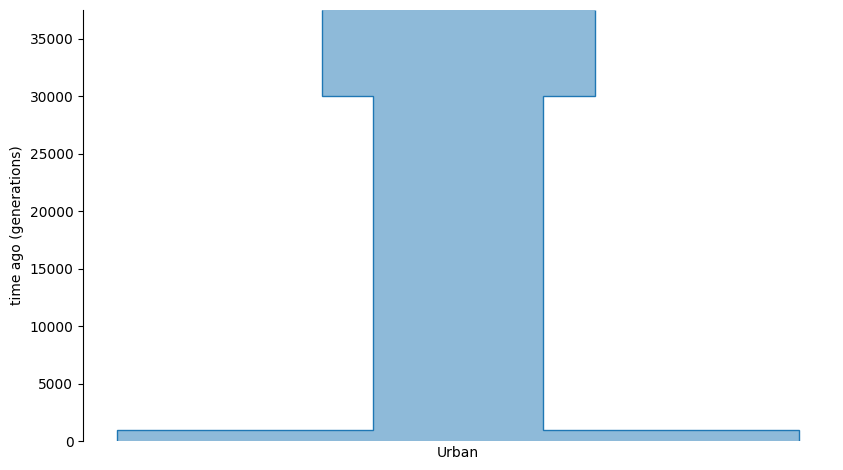
Populations: Urban
Single population of urban house Kobolds. Modern N=200000, rapid expansion 1000 gen ago (N=50000) tied to medieval urbanization, ancestral 30000 gen ago (N=80000).
UrbanRural_2D12
Two population urban and rural Kobold model
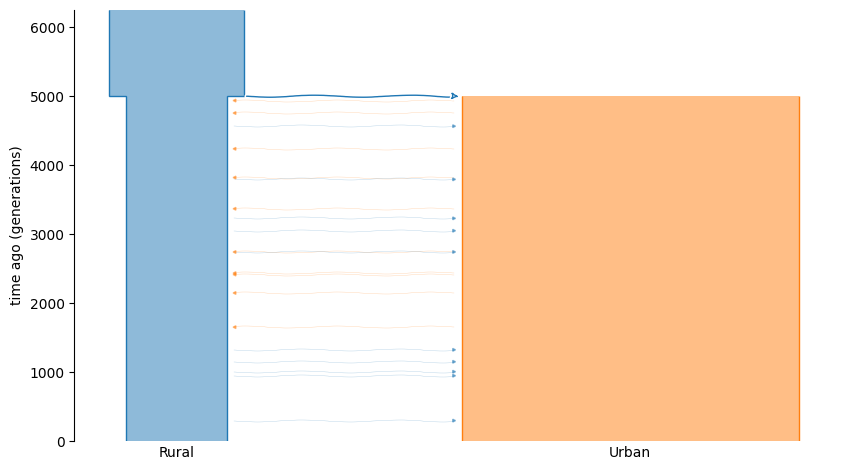
Populations: Urban, Rural
Urban and rural Kobold populations. Ancestral N=80000. Split 5000 gen ago with urbanization. Urban 200000, Rural 60000. Ongoing migration (2e-5) as Kobolds follow human settlement.
ThreeKoboldTypes_3D12
Three population Kobold model (urban, rural, mine)
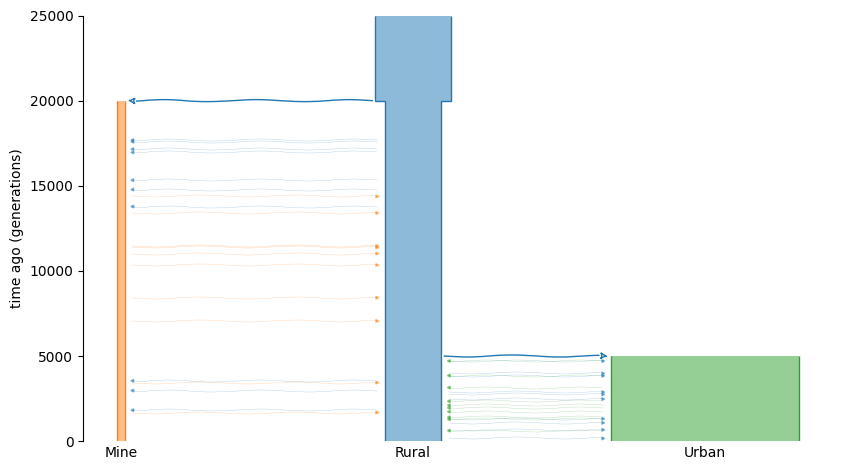
Populations: Urban, Rural, Mine
Three Kobold ecotypes. Ancestral rural population N=80000. Mine Kobolds diverge 20000 gen ago (deep subterranean niche). Urban Kobolds split from rural 5000 gen ago. Urban 200000, Rural 60000, Mine 8000. Rural-Mine migration 5e-6, Urban-Rural migration 2e-5.
MedievalUrbanBoom_1D12
Single population Kobold with medieval exponential urban growth
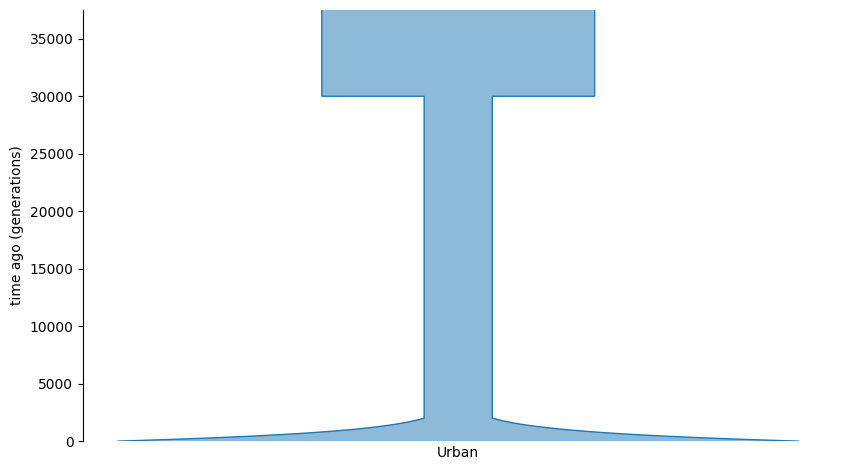
Populations: Urban
Single urban Kobold population with exponential growth tied to medieval urbanization. Modern N=200000, exponential growth from N=20000 starting 2000 gen ago (growth_rate ~0.001151). Ancestral stable N=80000 from 30000 gen ago.
UrbanRuralIM_2D12
Isolation-with-migration model for Urban and Rural Kobolds
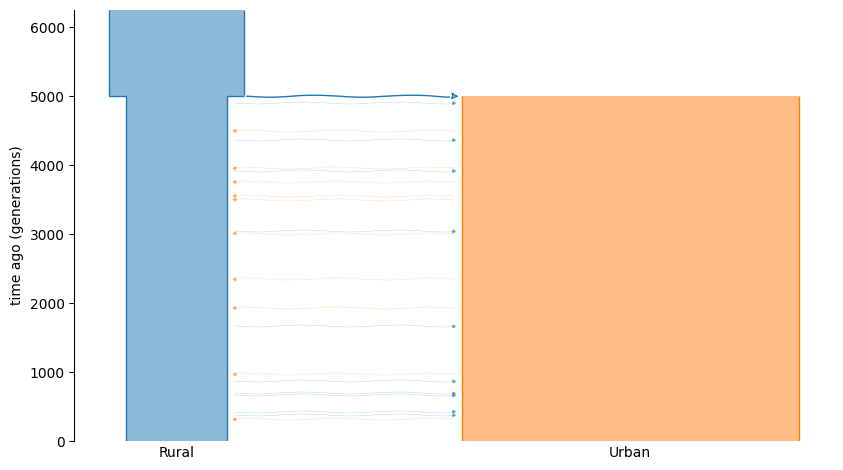
Populations: Urban, Rural
Urban and Rural Kobold populations under an isolation-with- migration framework. Split 5000 gen ago from ancestral N=80000. Asymmetric migration: Urban->Rural 1e-5, Rural->Urban 4e-5. Urban 200000, Rural 60000.
FourKoboldNiches_4D12
Four population Kobold model (urban, rural, mine, ship)
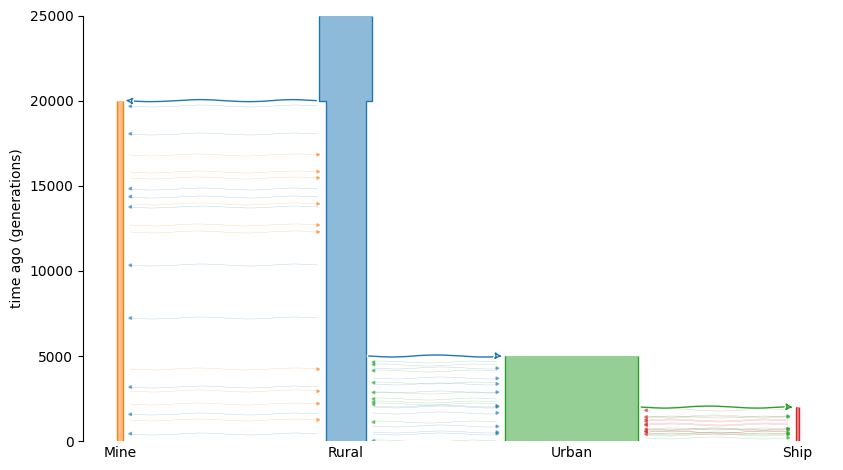
Populations: Urban, Rural, Mine, Ship
Four Kobold ecotypes: Urban, Rural, Mine, and Ship (Klabautermann). Ancestral rural population N=80000. Mine splits 20000 gen ago. Urban from Rural 5000 gen ago. Ship from Urban 2000 gen ago. Urban 200000, Rural 60000, Mine 8000, Ship 5000. Migration Urban-Ship 3e-5, Rural-Mine 5e-6.
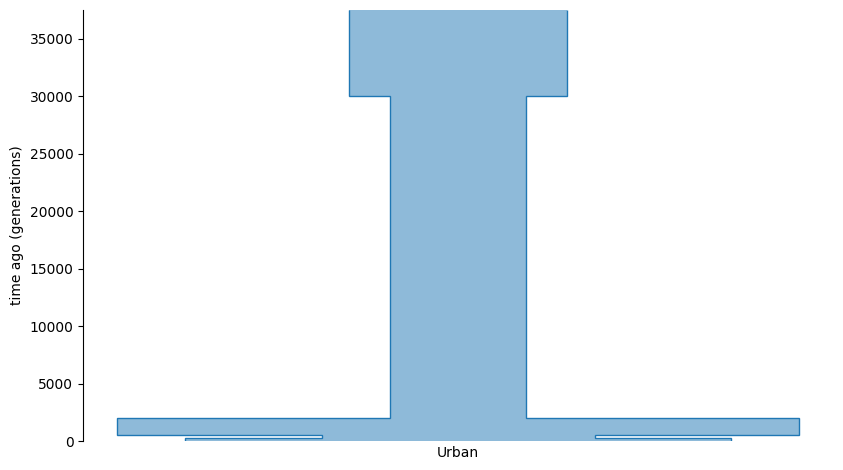
IndustrialDecline_1D12
Single population Kobold with industrial-era decline and recovery
Populations: Urban
Single Kobold population reflecting industrialization impacts. Modern N=200000, peak 500 gen ago N=250000, decline to 100000 at 300 gen ago, recovery to modern levels. Pre-industrial 2000 gen ago N=50000, ancestral 30000 gen ago N=80000.
Water & river spirits
Nix (Nixus rhenanus) — Water spirits from Rhine and Elbe folklore (Nix, Nixe).
Genome summary
- ID:
NixRhe- Species:
Nixus rhenanus
- Common name:
Nix (Rhine water spirit)
- Assembly:
RheinNix1.0(GCA_GRIM_000002)- Ploidy:
2
- Generation time:
50 years
- Population size:
45,000
Chromosomes
Name |
Length (bp) |
Mutation rate |
Recombination rate |
|---|---|---|---|
1 |
24,000,000 |
2.60e-08 |
2.80e-08 |
2 |
21,000,000 |
2.60e-08 |
2.80e-08 |
3 |
19,000,000 |
2.60e-08 |
2.80e-08 |
4 |
17,000,000 |
2.60e-08 |
2.80e-08 |
5 |
15,000,000 |
2.60e-08 |
2.80e-08 |
river_mitogenome |
15,500 |
8.00e-08 |
0.00e+00 |
Demographic models
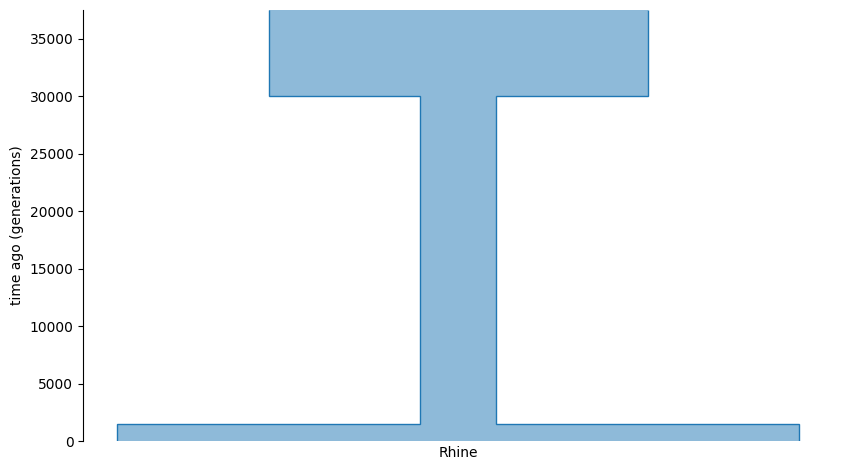
Rhine_1D12
Single population Rhine Nix model
Populations: Rhine
Single population of water spirits in the Rhine. Modern N=45000, bottleneck 1500 gen ago (N=5000), ancestral 30000 gen ago (N=25000).
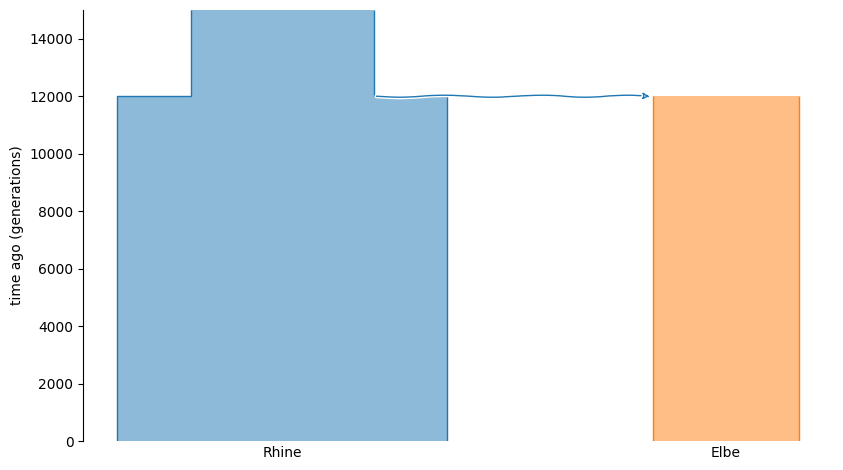
RhineElbe_2D12
Two population Rhine and Elbe Nix model
Populations: Rhine, Elbe
Rhine and Elbe river populations. Ancestral N=25000. Split 12000 gen ago. Rhine 45000, Elbe 20000.
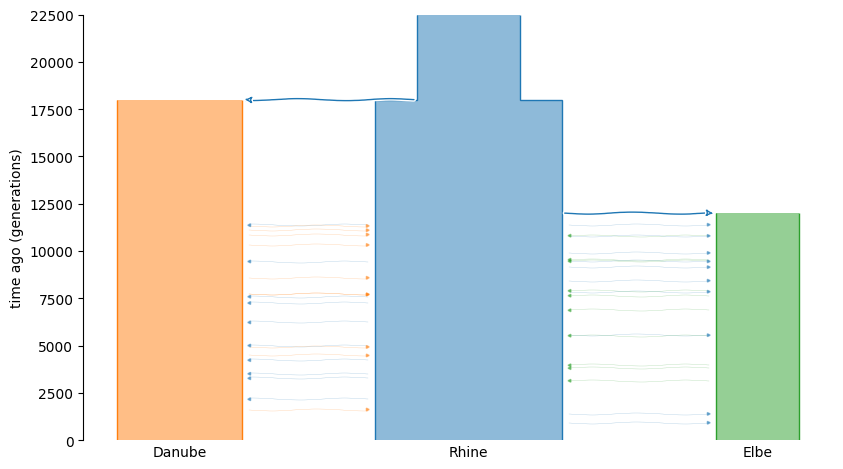
ThreeRivers_3D12
Three river Nix population model (Rhine, Elbe, Danube)
Populations: Rhine, Elbe, Danube
Three river populations of water spirits. Ancestral N=25000. Rhine-Danube split 18000 gen ago. Elbe branches from Rhine 12000 gen ago. Rhine at 45000, Elbe at 20000, Danube at 30000. Continuous low migration Rhine-Elbe (5e-6) and Rhine-Danube (2e-6).
RhineBottleneck_1D12
Single population with severe industrial bottleneck
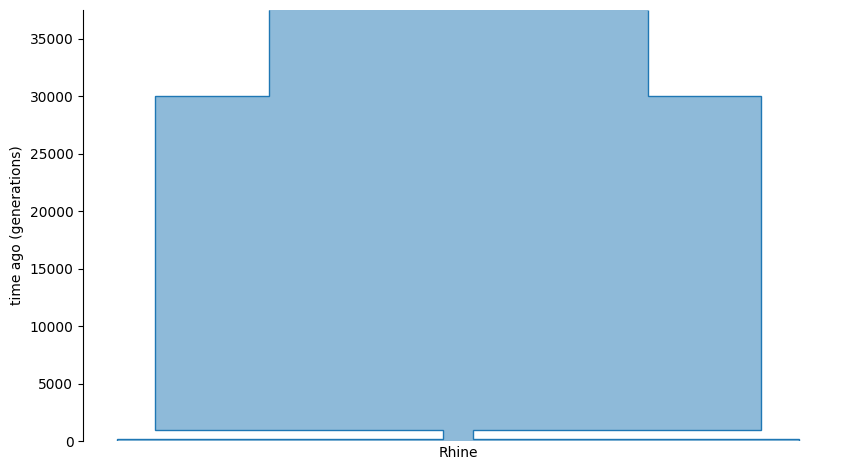
Populations: Rhine
Single population of Rhine Nixes with a severe industrial-era bottleneck. Modern N=45000, industrialization/pollution bottleneck 200 gen ago (N=2000), pre-industrial 1000 gen ago (N=40000), ancestral 30000 gen ago (N=25000).
RhineElbeIM_2D12
IM model between Rhine and Elbe with asymmetric migration
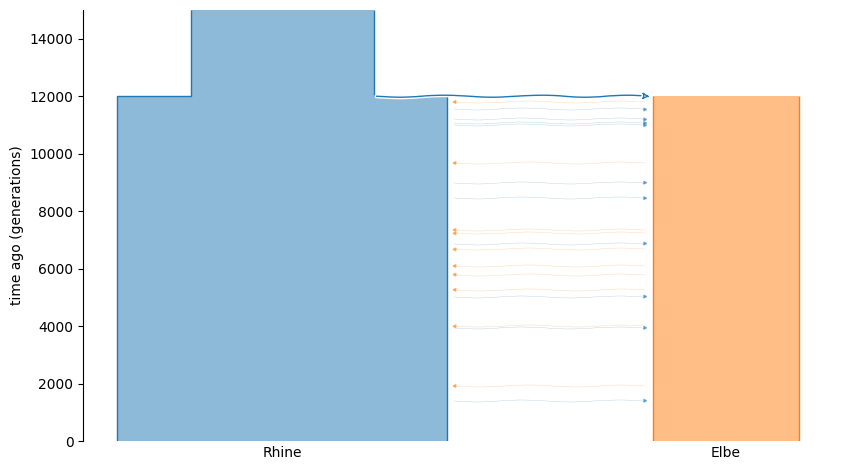
Populations: Rhine, Elbe
Isolation-with-migration model between Rhine and Elbe Nixes. Rhine N=45000, Elbe N=20000. Split 12000 gen ago from ancestral N=25000. Asymmetric migration: Rhine->Elbe 1e-5, Elbe->Rhine 3e-6.
FourRivers_4D12
Four river Nix stepping-stone model
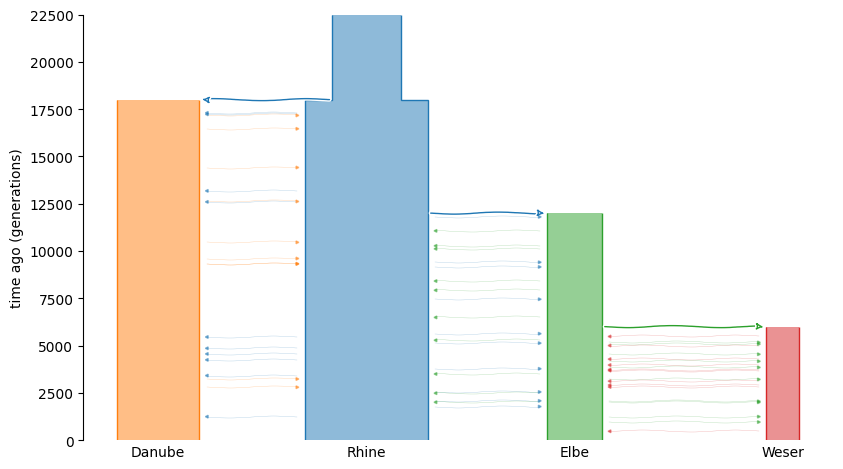
Populations: Rhine, Elbe, Danube, Weser
Four river populations of water spirits: Rhine, Elbe, Danube, and Weser. Ancestral N=25000. Danube splits from Rhine 18000 gen ago. Elbe splits from Rhine 12000 gen ago. Weser splits from Elbe 6000 gen ago. Rhine 45000, Elbe 20000, Danube 30000, Weser 12000. Stepping-stone migration: Rhine-Elbe 5e-6, Elbe-Weser 8e-6, Rhine-Danube 2e-6.
TidalFluctuation_1D12
Single population with oscillating size representing tidal fluctuations
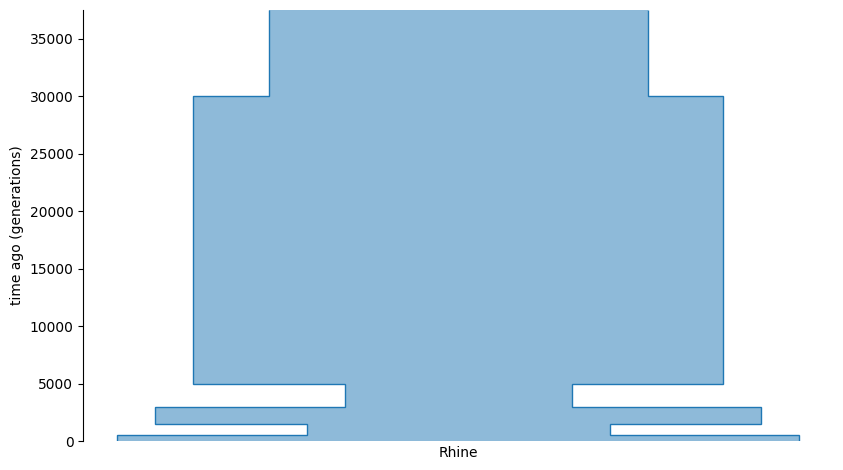
Populations: Rhine
Single population of Rhine Nixes with oscillating population size representing seasonal/tidal fluctuations over deep time. Modern N=45000, 500 gen ago N=20000, 1500 gen ago N=40000, 3000 gen ago N=15000, 5000 gen ago N=35000, ancestral 30000 gen ago N=25000.
Loreley (Loreley rhenanus) — The spirit of the Loreley rock on the Rhine (Brentano, Heine).
Genome summary
- ID:
LorRhe- Species:
Loreley rhenanus
- Common name:
Loreley (Rhine rock spirit)
- Assembly:
Loreley1.0(GCA_GRIM_000005)- Ploidy:
2
- Generation time:
40 years
- Population size:
35,000
Chromosomes
Name |
Length (bp) |
Mutation rate |
Recombination rate |
|---|---|---|---|
1 |
25,000,000 |
2.50e-08 |
2.70e-08 |
2 |
22,000,000 |
2.50e-08 |
2.70e-08 |
3 |
20,000,000 |
2.50e-08 |
2.70e-08 |
4 |
18,000,000 |
2.50e-08 |
2.70e-08 |
5 |
16,000,000 |
2.50e-08 |
2.70e-08 |
rock_mitogenome |
16,200 |
8.00e-08 |
0.00e+00 |
Demographic models
LoreleyRock_1D12
Single population Loreley (Rhine rock) model
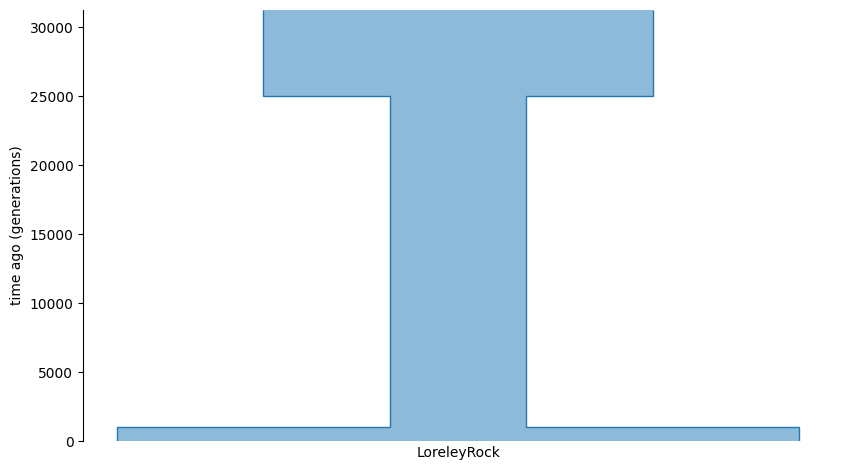
Populations: LoreleyRock
Single population at the Loreley rock, Middle Rhine. Modern N=35000, bottleneck 1000 gen ago (N=7000), ancestral 25000 gen ago (N=20000).
LoreleyMiddleRhine_2D12
Two population Loreley rock and Middle Rhine model
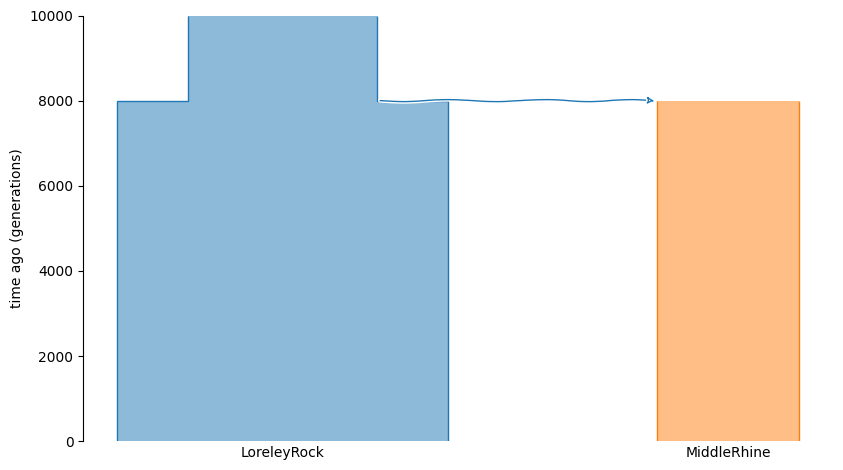
Populations: LoreleyRock, MiddleRhine
Loreley rock and Middle Rhine. Ancestral N=20000. Split 8000 gen ago. Loreley 35000, Middle Rhine 15000.
RhineGorge_3D12
Three population Rhine gorge Loreley model
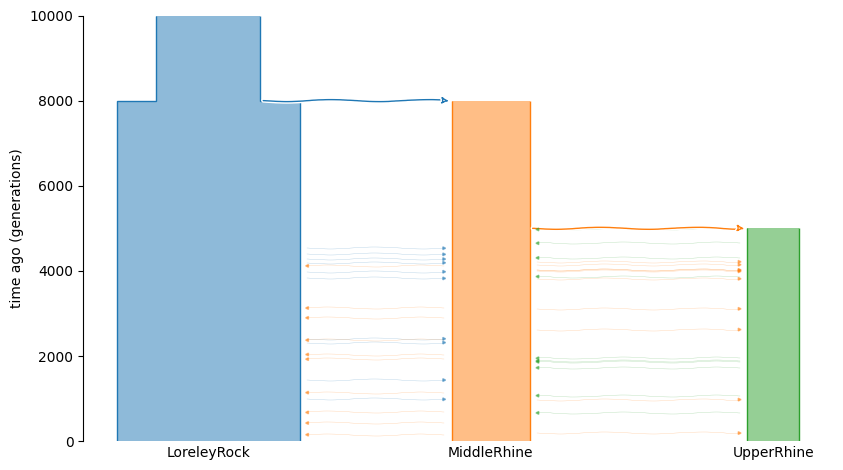
Populations: LoreleyRock, MiddleRhine, UpperRhine
Three populations along the Rhine: Loreley Rock, Middle Rhine, and Upper Rhine. Ancestral N=20000. Middle Rhine splits from Loreley 8000 gen ago. Upper Rhine colonized from Middle Rhine 5000 gen ago. Loreley 35000, Middle Rhine 15000, Upper Rhine 10000. Migration between adjacent populations (1e-5 per gen).
LoreleyDecline_1D12
Single population Loreley decline and recovery model
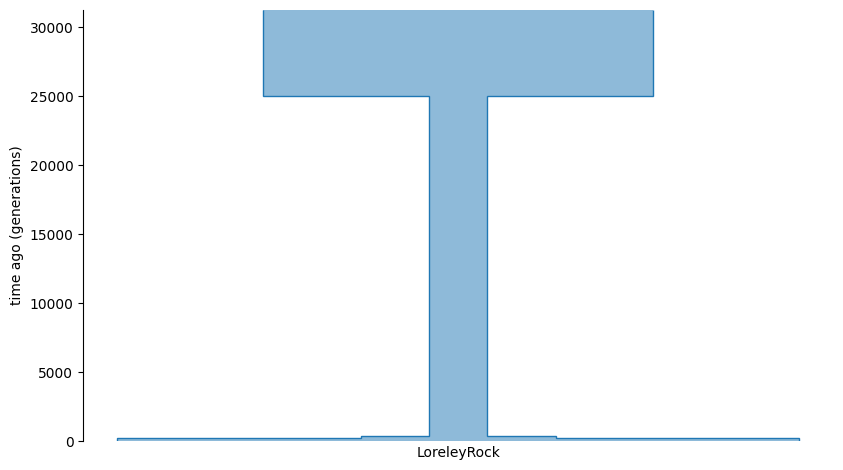
Populations: LoreleyRock
Single population at the Loreley rock with industrial decline and recovery. Modern N=35000, decline at 400 gen ago to N=3000 (river traffic/industrialization), recovery at 200 gen ago to N=10000, then modern expansion. Ancestral 25000 gen ago N=20000.
LoreleyMiddleRhineIM_2D12
Isolation-with-migration model for Loreley and Middle Rhine
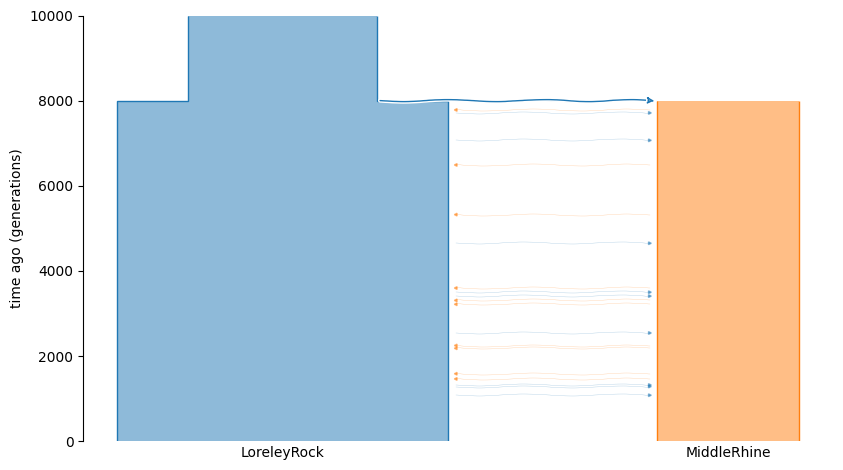
Populations: LoreleyRock, MiddleRhine
Isolation-with-migration model. Loreley rock N=35000, Middle Rhine N=15000. Split 8000 gen ago from ancestral N=20000. Migration Loreley->Middle 2e-5, Middle->Loreley 8e-6.
FourRhineStretches_4D12
Four population Rhine stretches model
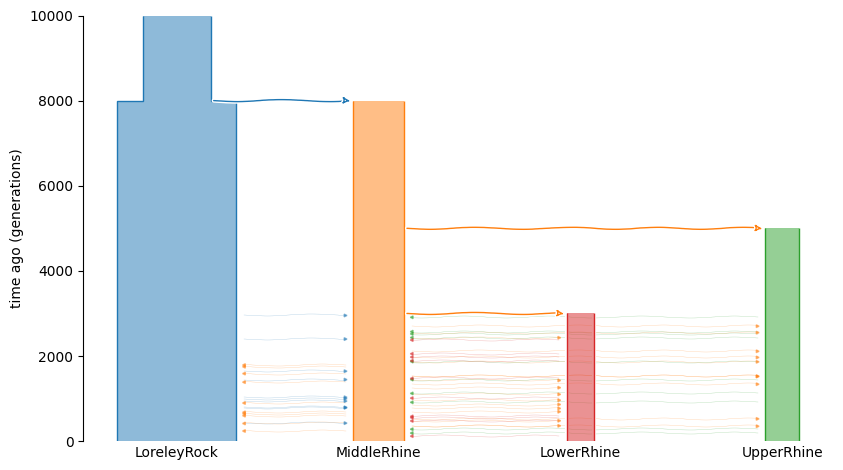
Populations: LoreleyRock, MiddleRhine, UpperRhine, LowerRhine
Four populations along the Rhine: Loreley Rock, Middle Rhine, Upper Rhine, and Lower Rhine. Ancestral N=20000. Middle Rhine splits from Loreley 8000 gen ago. Upper Rhine from Middle Rhine 5000 gen ago. Lower Rhine from Middle Rhine 3000 gen ago. Loreley 35000, Middle Rhine 15000, Upper Rhine 10000, Lower Rhine 8000. Stepping-stone migration.
SirenSong_1D12
Single population Loreley siren song model with ancient expansion
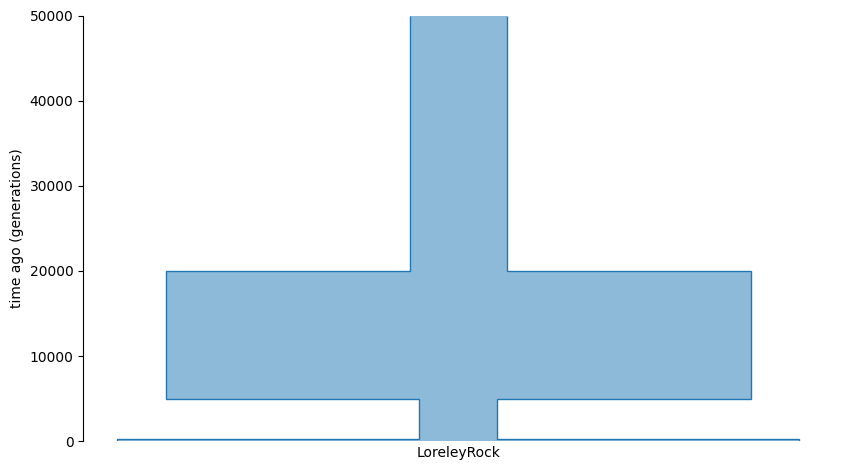
Populations: LoreleyRock
Single population with ancient expansion and recent bottleneck. Modern N=35000, bottleneck 300 gen ago N=4000, stable 5000 gen ago N=30000, expansion from N=5000 at 20000 gen ago, founding 40000 gen ago N=5000.
Flussfee (Flussfee aquaticus) — River fairies of the Rhine tributaries (Main, Moselle, Neckar), linked to regional German river folklore.
Genome summary
- ID:
FeeFlu- Species:
Flussfee aquaticus
- Common name:
Flussfee (River Fairy)
- Assembly:
Flussfee1.0(GCA_GRIM_000014)- Ploidy:
2
- Generation time:
30 years
- Population size:
55,000
Chromosomes
Name |
Length (bp) |
Mutation rate |
Recombination rate |
|---|---|---|---|
1 |
20,000,000 |
2.70e-08 |
2.90e-08 |
2 |
18,000,000 |
2.70e-08 |
2.90e-08 |
3 |
16,000,000 |
2.70e-08 |
2.90e-08 |
4 |
14,000,000 |
2.70e-08 |
2.90e-08 |
5 |
12,000,000 |
2.70e-08 |
2.90e-08 |
aquatic_mitogenome |
15,800 |
8.00e-08 |
0.00e+00 |
Demographic models
MainRiver_1D12
Single population Main river fairy model
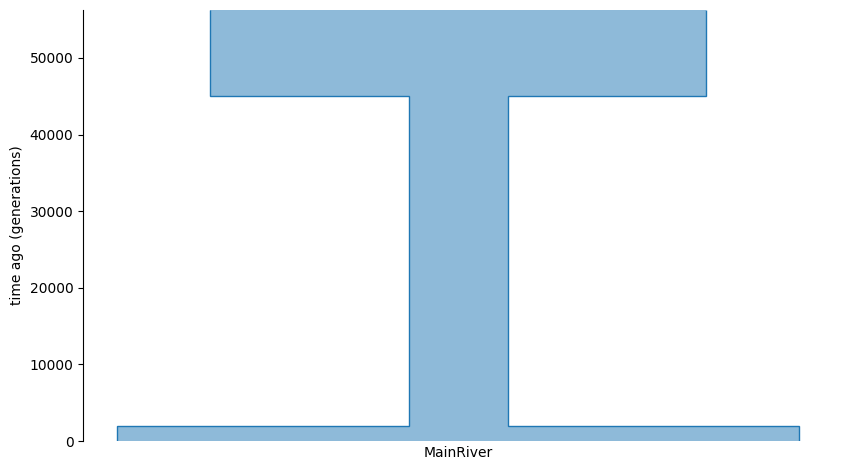
Populations: MainRiver
Single population of river fairies along the Main. Modern N=55000, decline 2000 gen ago (N=8000) due to river channeling, ancestral 45000 gen ago (N=40000).
MainMoselle_2D12
Two population Main-Moselle river fairy model
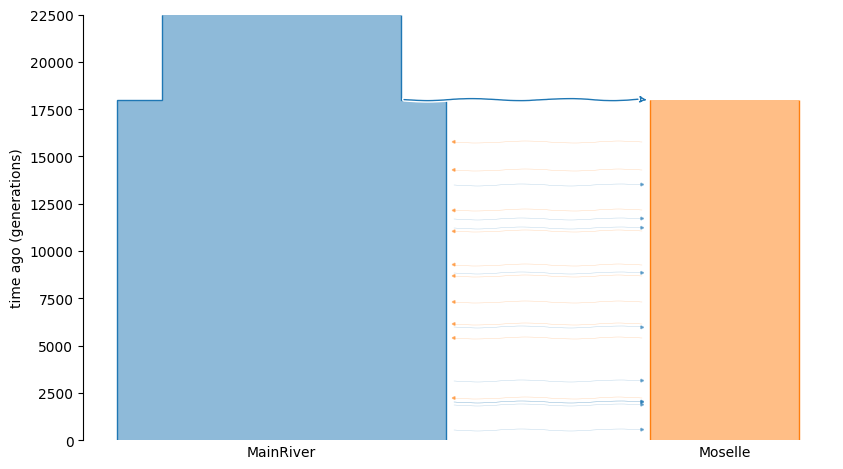
Populations: MainRiver, Moselle
Main and Moselle river fairy populations. Ancestral N=40000. Split 18000 gen ago at Rhine confluence divergence. Main 55000, Moselle 25000. Migration (8e-6) via Rhine.
ThreeTributaries_3D12
Three population river fairy model (Main, Moselle, Neckar)
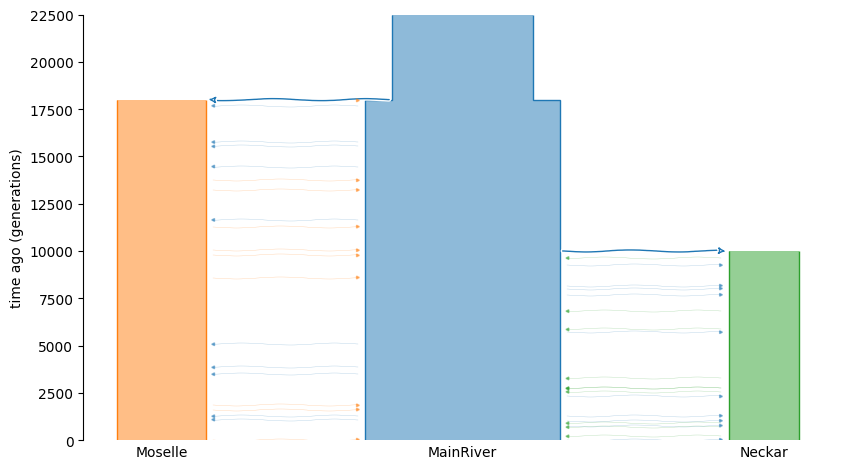
Populations: MainRiver, Moselle, Neckar
Three Rhine tributary fairy populations. Ancestral N=40000. Main-Moselle split 18000 gen ago. Neckar splits from Main 10000 gen ago. Main 55000, Moselle 25000, Neckar 20000. Stepping-stone via Rhine: Main-Moselle 8e-6, Main-Neckar 1e-5.
RiverPollution_1D12
Single population model with pollution bottleneck
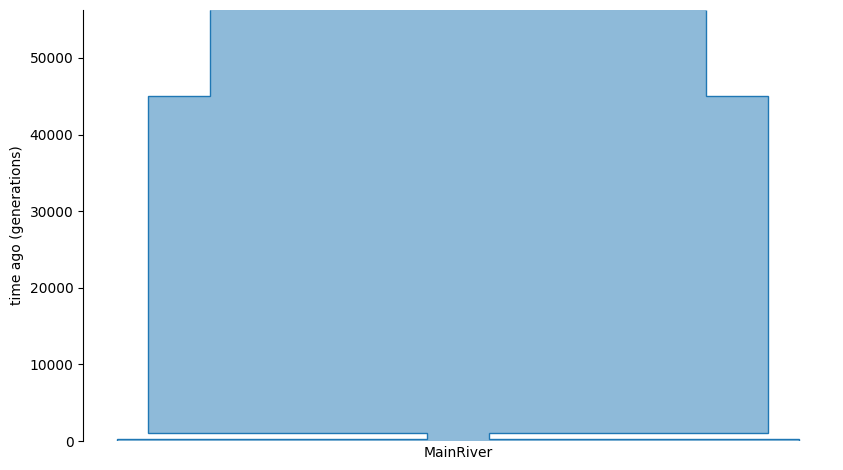
Populations: MainRiver
Single population river fairy model with pollution bottleneck. Modern N=55000, pollution bottleneck 300 gen ago (N=5000), pre-industrial 1000 gen ago N=50000, ancestral 45000 gen ago N=40000.
MainMoselleIM_2D12
Isolation-with-migration model for Main and Moselle
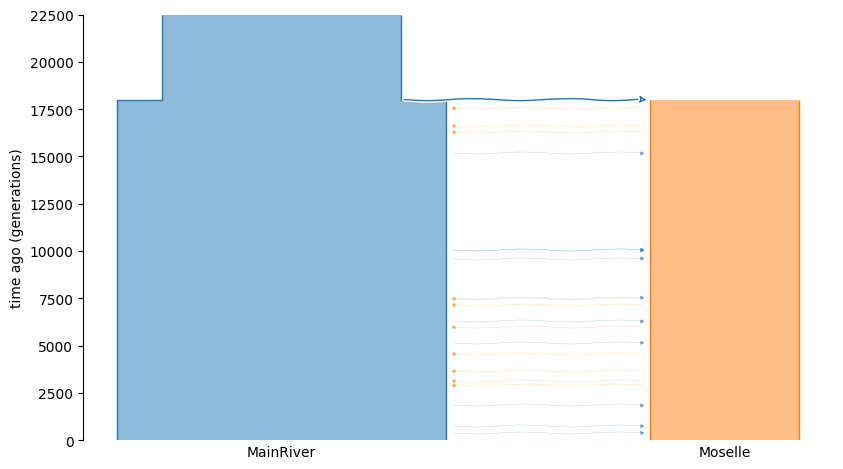
Populations: MainRiver, Moselle
Isolation-with-migration model for Main and Moselle river fairies. Main 55000, Moselle 25000. Split 18000 gen ago from ancestral N=40000. Asymmetric migration: Main->Moselle 1e-5, Moselle->Main 5e-6.
FourTributaries_4D12
Four population river fairy model (Main, Moselle, Neckar, Lahn)
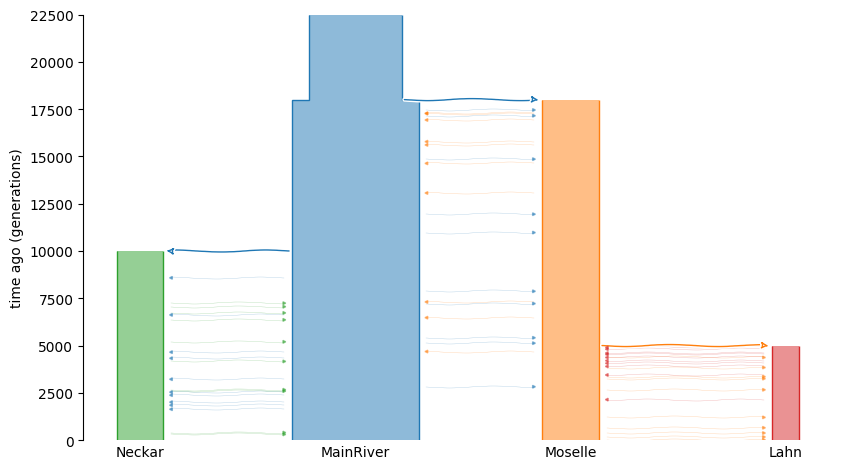
Populations: MainRiver, Moselle, Neckar, Lahn
Four Rhine tributary fairy populations. Ancestral N=40000. Moselle splits from Main 18000 gen ago. Neckar from Main 10000 gen ago. Lahn from Moselle 5000 gen ago. Main 55000, Moselle 25000, Neckar 20000, Lahn 12000.
SpringFlood_1D12
Single population with spring flood oscillations
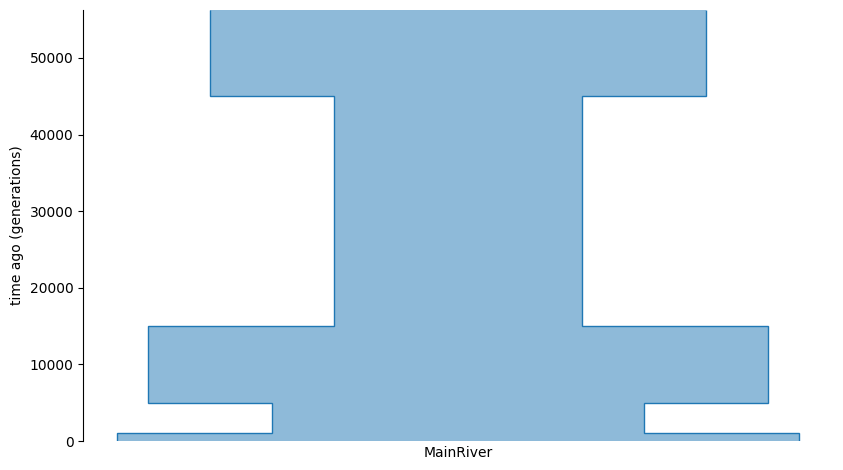
Populations: MainRiver
Single population river fairy model with oscillating size reflecting spring flood cycles. Modern N=55000, 1000 gen ago N=30000, 5000 gen ago N=50000, 15000 gen ago N=20000, 45000 gen ago N=40000.
FairyRingExpansion_1D12
Single population exponential growth model for river fairies
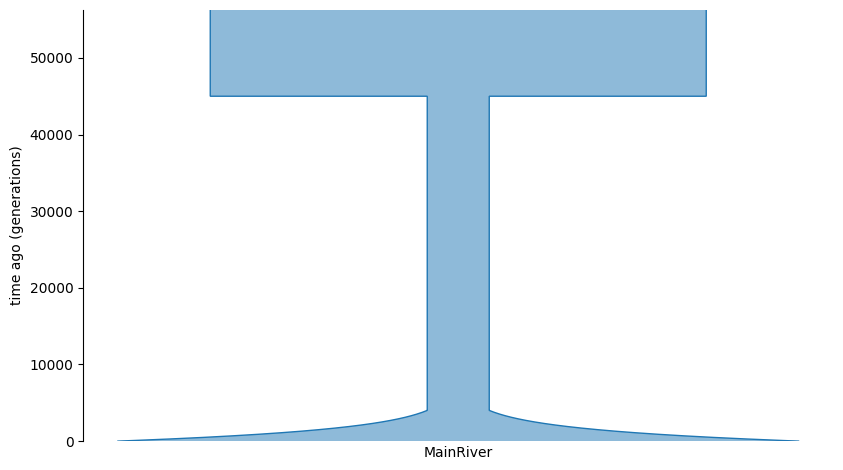
Populations: MainRiver
Single population river fairy model with exponential growth. Modern N=55000, exponential growth from N=5000 starting 4000 gen ago. Before that stable at 5000 from 45000 gen ago at N=40000. growth_rate = ln(55000/5000)/4000 ~ 0.000598.
Forest & nocturnal spirits
Erlkoenig (Erlkoenig sylvestris) — The Alder King of Goethe’s ballad and Herder’s Danish Ellerkonge translation, haunting forest paths at dusk.
Genome summary
- ID:
ErlKoe- Species:
Erlkoenig sylvestris
- Common name:
Erlkoenig (Alder King)
- Assembly:
Erlkoenig1.0(GCA_GRIM_000009)- Ploidy:
2
- Generation time:
45 years
- Population size:
30,000
Chromosomes
Name |
Length (bp) |
Mutation rate |
Recombination rate |
|---|---|---|---|
1 |
27,000,000 |
2.50e-08 |
2.60e-08 |
2 |
24,000,000 |
2.50e-08 |
2.60e-08 |
3 |
21,000,000 |
2.50e-08 |
2.60e-08 |
4 |
19,000,000 |
2.50e-08 |
2.60e-08 |
5 |
17,000,000 |
2.50e-08 |
2.60e-08 |
alder_mitogenome |
16,800 |
7.50e-08 |
0.00e+00 |
Demographic models
Thuringian_1D12
Single population Thuringian Erlkoenig model
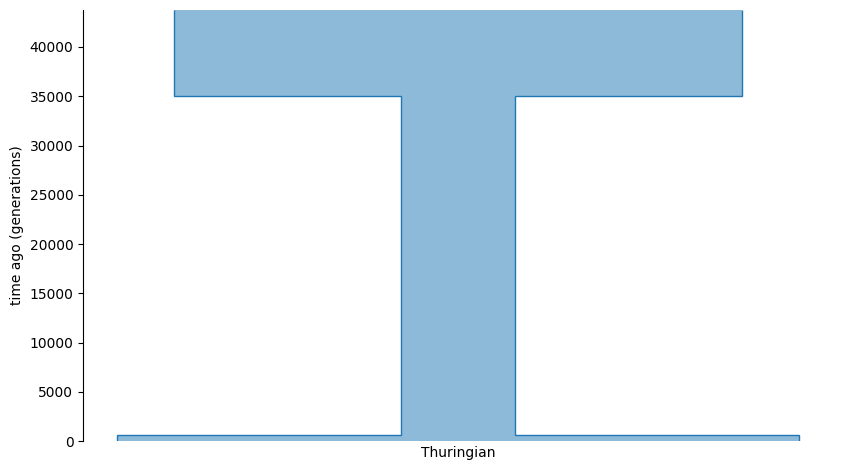
Populations: Thuringian
Single population in the Thuringian forest. Modern N=30000, decline 600 gen ago (N=5000) due to deforestation, ancestral 35000 gen ago (N=25000).
ThuringianBaltic_2D12
Two population Thuringian-Baltic Erlkoenig model
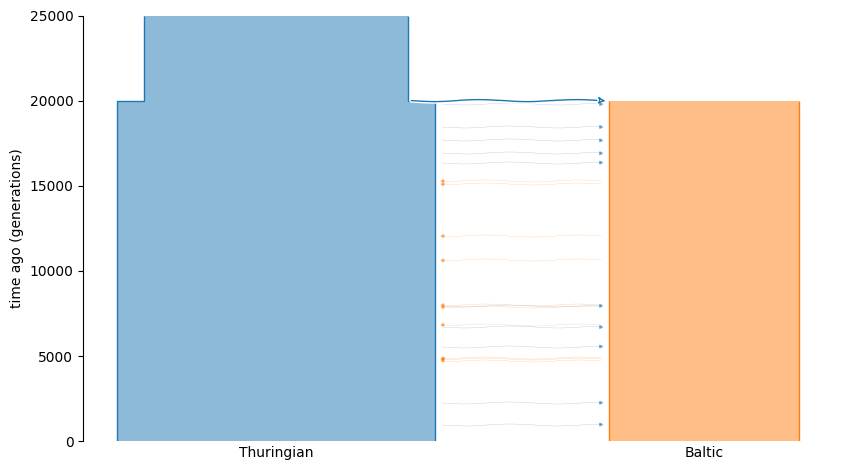
Populations: Thuringian, Baltic
Thuringian and Baltic (Danish Ellerkonge) populations. Ancestral N=25000. Split 20000 gen ago. Thuringian 30000, Baltic 18000. Low migration (3e-6) via forest corridors.
ThreeForestRealms_3D12
Three population Erlkoenig model (Thuringian, Baltic, Bohemian)
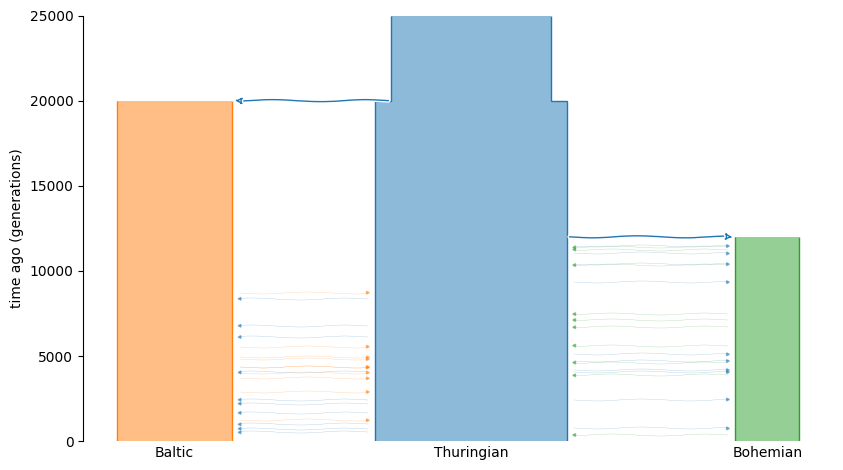
Populations: Thuringian, Baltic, Bohemian
Three Erlkoenig populations across northern/central Europe. Ancestral N=25000. Baltic splits 20000 gen ago. Bohemian splits from Thuringian 12000 gen ago. Thuringian 30000, Baltic 18000, Bohemian 10000. Stepping-stone migration.
DeforestationDecline_1D12
Single population Erlkoenig with medieval deforestation decline
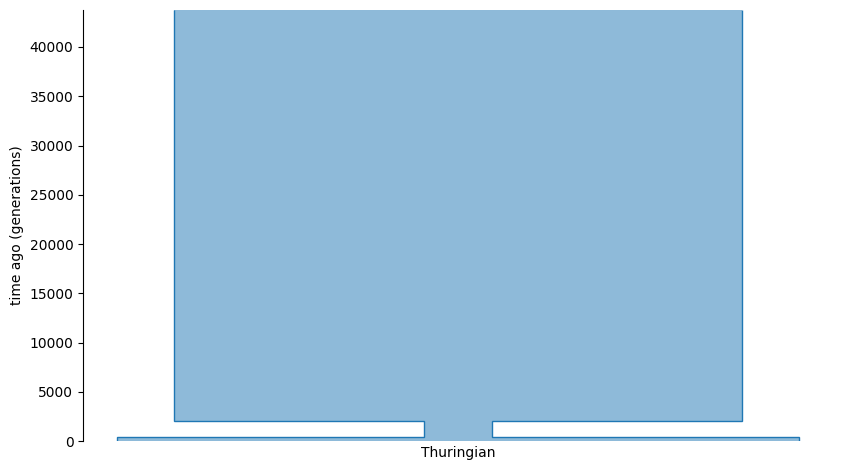
Populations: Thuringian
Single Erlkoenig population experiencing severe decline during medieval deforestation (400 gen ago, N=3000). Stable at N=25000 from 2000 gen ago, ancestral N=25000 from 35000 gen ago. Modern recovery to N=30000.
ThuringianBalticIM_2D12
Isolation-with-migration model for Thuringian and Baltic Erlkoenig
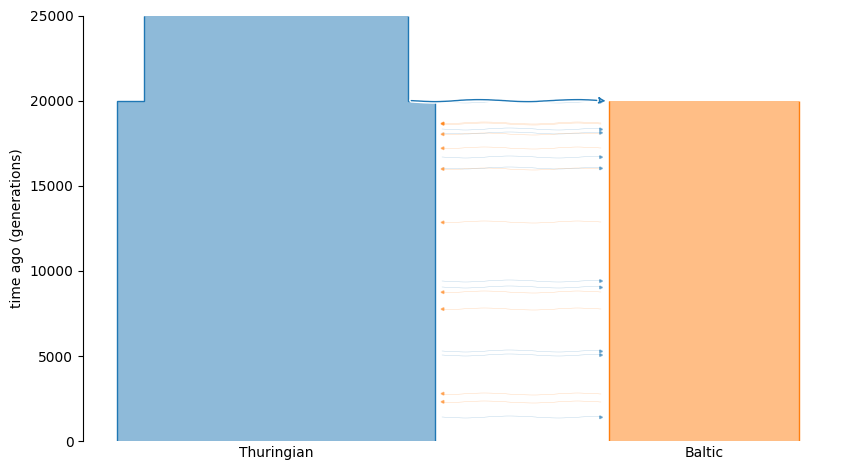
Populations: Thuringian, Baltic
Thuringian and Baltic Erlkoenig populations under an isolation- with-migration framework. Split 20000 gen ago from ancestral N=25000. Asymmetric migration: Thuringian->Baltic 5e-6, Baltic->Thuringian 2e-6. Thuringian 30000, Baltic 18000.
FourForestDomains_4D12
Four population Erlkoenig model across forest domains
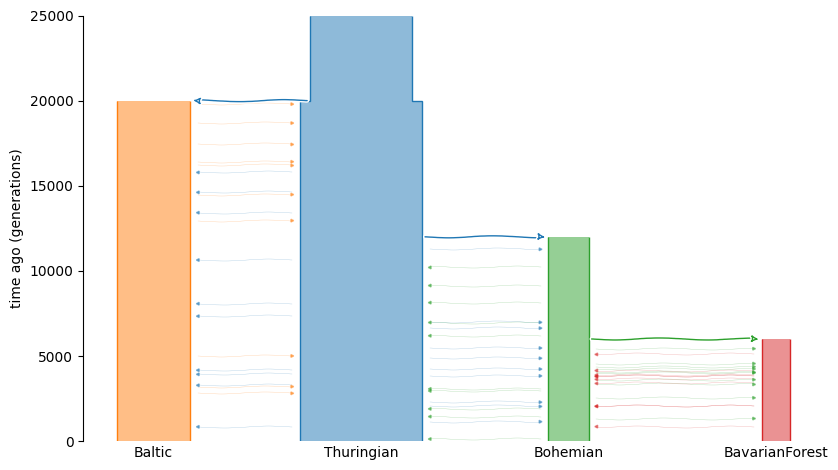
Populations: Thuringian, Baltic, Bohemian, BavarianForest
Four Erlkoenig populations: Thuringian, Baltic, Bohemian, and Bavarian Forest. Ancestral N=25000. Baltic splits 20000 gen ago. Bohemian from Thuringian 12000 gen ago. BavarianForest from Bohemian 6000 gen ago. Thuringian 30000, Baltic 18000, Bohemian 10000, Bavarian 7000.
AncientWoodland_1D12
Single population Erlkoenig with ancient woodland expansion history
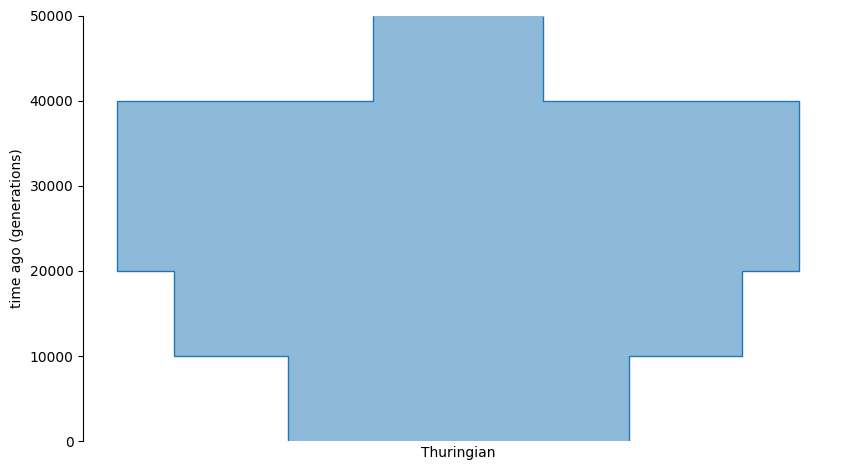
Populations: Thuringian
Single Erlkoenig population tracing deep woodland history. Modern N=30000 stable to 5000 gen ago. Ancient larger woodland population N=50000 at 10000 gen ago. Peak N=60000 at 20000 gen ago. Founding population N=15000 at 40000 gen ago.
Alp (Alpus nocturnalis) — The nightmare spirit (Alpdruck) that sits on sleepers’ chests, widespread in German and Alpine folklore.
Genome summary
- ID:
AlpNac- Species:
Alpus nocturnalis
- Common name:
Alp (nightmare spirit)
- Assembly:
Alpdruck1.0(GCA_GRIM_000011)- Ploidy:
2
- Generation time:
10 years
- Population size:
150,000
Chromosomes
Name |
Length (bp) |
Mutation rate |
Recombination rate |
|---|---|---|---|
1 |
18,000,000 |
2.60e-08 |
2.70e-08 |
2 |
16,000,000 |
2.60e-08 |
2.70e-08 |
3 |
14,000,000 |
2.60e-08 |
2.70e-08 |
4 |
12,000,000 |
2.60e-08 |
2.70e-08 |
5 |
10,000,000 |
2.60e-08 |
2.70e-08 |
nocturnal_mitogenome |
15,200 |
8.50e-08 |
0.00e+00 |
Demographic models
SwabianAlp_1D12
Single population Swabian Alp nightmare spirit model
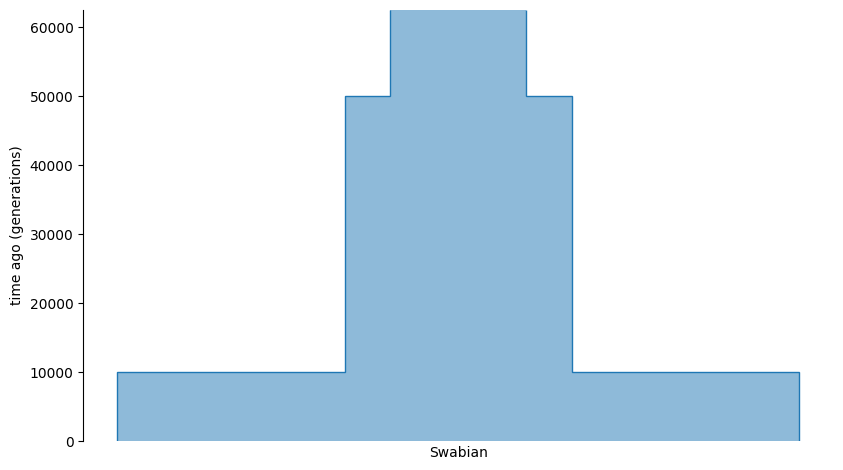
Populations: Swabian
Single population of Alps in the Swabian Alb. Modern N=150000, steady growth from 50000 over 10000 gen, ancestral 50000 gen ago (N=30000).
SwabianSaxon_2D12
Two population Swabian-Saxon Alp model
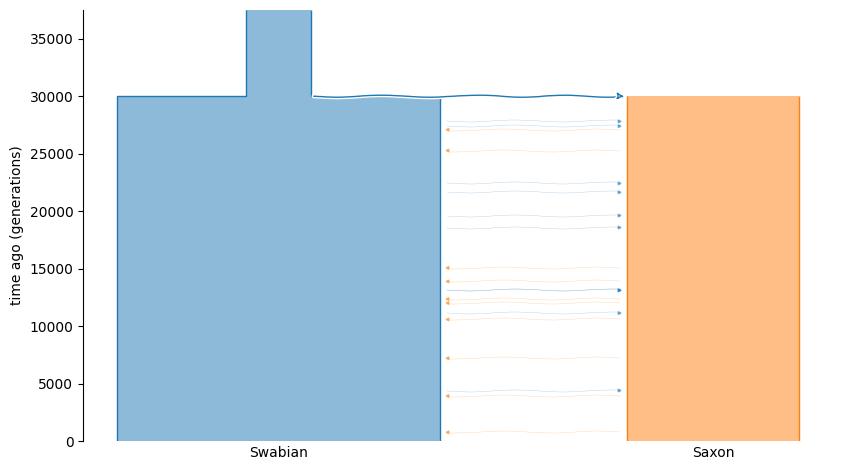
Populations: Swabian, Saxon
Swabian and Saxon Alp populations. Ancestral N=30000. Split 30000 gen ago. Swabian 150000, Saxon 80000. Migration (1e-5) reflecting nocturnal range overlap.
ThreeAlpRegions_3D12
Three population Alp model (Swabian, Saxon, Alpine)
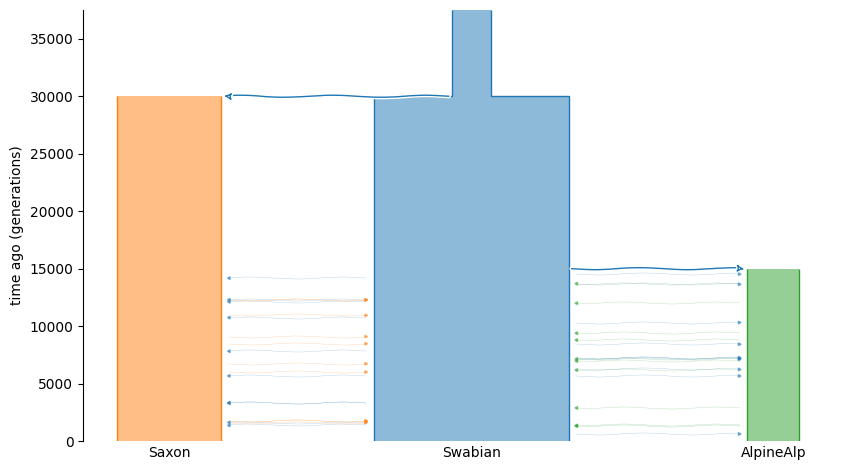
Populations: Swabian, Saxon, AlpineAlp
Three regional Alp populations. Ancestral N=30000. Swabian-Saxon split 30000 gen ago. Alpine splits from Swabian 15000 gen ago. Swabian 150000, Saxon 80000, Alpine 40000. Stepping-stone migration pattern.
NightmareExpansion_1D12
Single population Alp model with exponential nightmare expansion
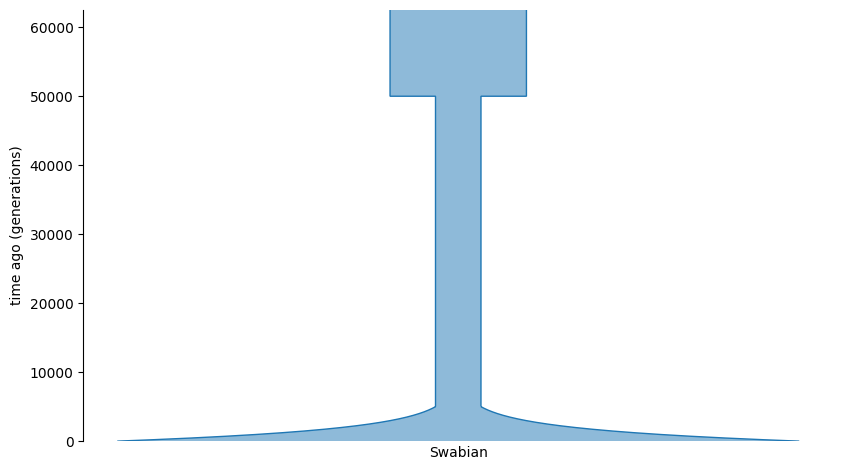
Populations: Swabian
Single Alp population with exponential growth. Modern N=150000, exponential growth from N=10000 starting 5000 gen ago (growth_rate ~0.000542). Ancestral 50000 gen ago (N=30000).
SwabianSaxonIM_2D12
Isolation-with-migration model for Swabian and Saxon Alps
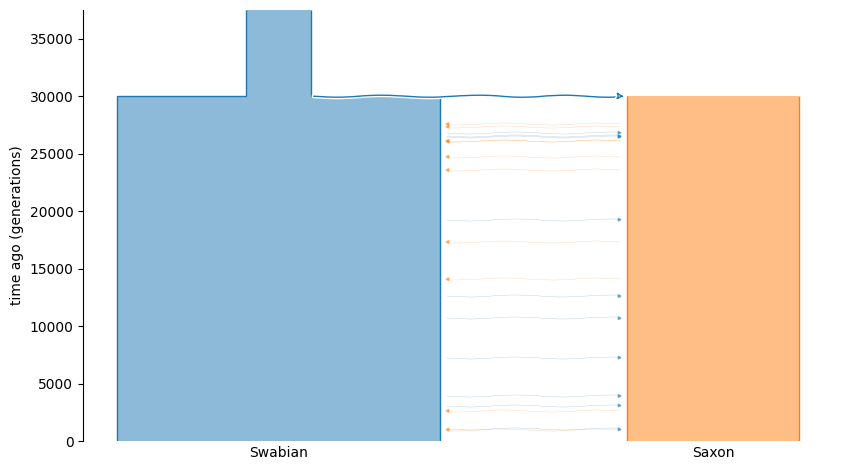
Populations: Swabian, Saxon
Isolation-with-migration (IM) model for Swabian and Saxon Alp populations. Swabian 150000, Saxon 80000. Split 30000 gen ago from ancestral N=30000. Asymmetric migration: Swabian->Saxon 5e-6, Saxon->Swabian 2e-6.
FourAlpRegions_4D12
Four population Alp model (Swabian, Saxon, Alpine, Rhineland)
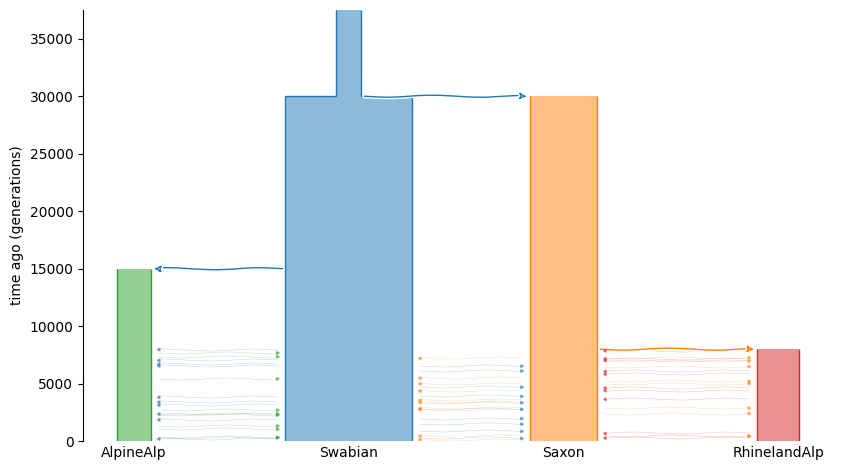
Populations: Swabian, Saxon, AlpineAlp, RhinelandAlp
Four regional Alp populations. Ancestral N=30000. Saxon splits 30000 gen ago. Alpine splits from Swabian 15000 gen ago. Rhineland splits from Saxon 8000 gen ago. Swabian 150000, Saxon 80000, Alpine 40000, Rhineland 50000.
SleepParalysis_1D12
Single population Alp model with oscillating population size
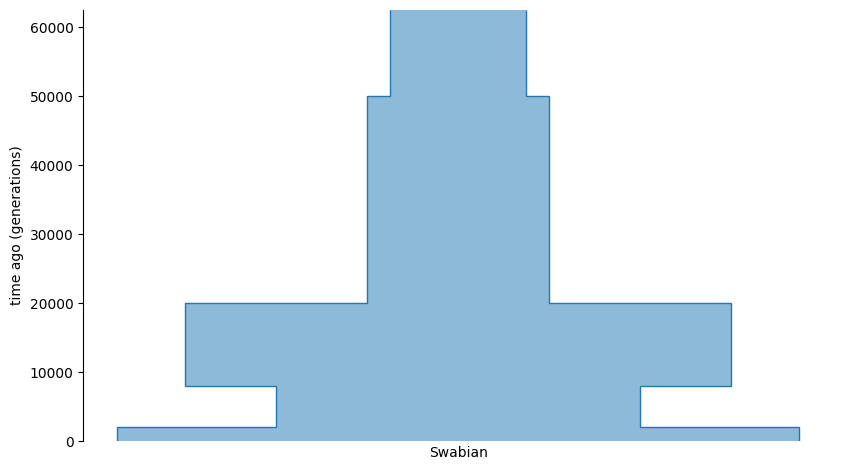
Populations: Swabian
Single Alp population with oscillating population sizes reflecting cycles of nightmare prevalence. Modern N=150000, 2000 gen ago N=80000, 8000 gen ago N=120000, 20000 gen ago N=40000, 50000 gen ago N=30000.
Wilde Jagd (Wildjaeger germanicus) — The Wild Hunt, a spectral host of riders that sweeps across the night sky (Grimm, Deutsche Mythologie).
Genome summary
- ID:
WilJae- Species:
Wildjaeger germanicus
- Common name:
Wilde Jagd (Wild Hunt)
- Assembly:
WildeJagd1.0(GCA_GRIM_000007)- Ploidy:
2
- Generation time:
60 years
- Population size:
25,000
Chromosomes
Name |
Length (bp) |
Mutation rate |
Recombination rate |
|---|---|---|---|
1 |
30,000,000 |
2.40e-08 |
2.30e-08 |
2 |
27,000,000 |
2.40e-08 |
2.30e-08 |
3 |
24,000,000 |
2.40e-08 |
2.30e-08 |
4 |
21,000,000 |
2.40e-08 |
2.30e-08 |
5 |
19,000,000 |
2.40e-08 |
2.30e-08 |
6 |
17,000,000 |
2.40e-08 |
2.30e-08 |
spectral_mitogenome |
19,000 |
6.50e-08 |
0.00e+00 |
Demographic models
NorthernHunt_1D12
Single population Northern Wild Hunt model
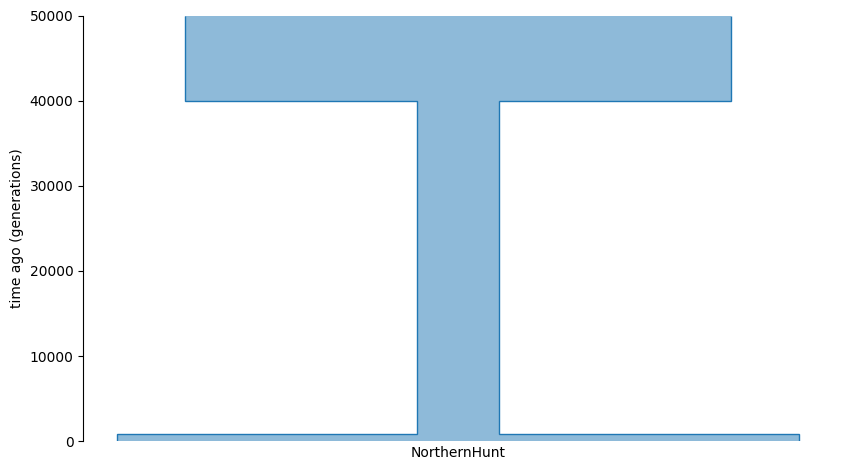
Populations: NorthernHunt
Single population of spectral hunters on the North German Plain. Modern N=25000, bottleneck during Christianization 800 gen ago (N=3000), ancestral 40000 gen ago (N=20000).
NorthSouthHunt_2D12
Two population North-South Wild Hunt model
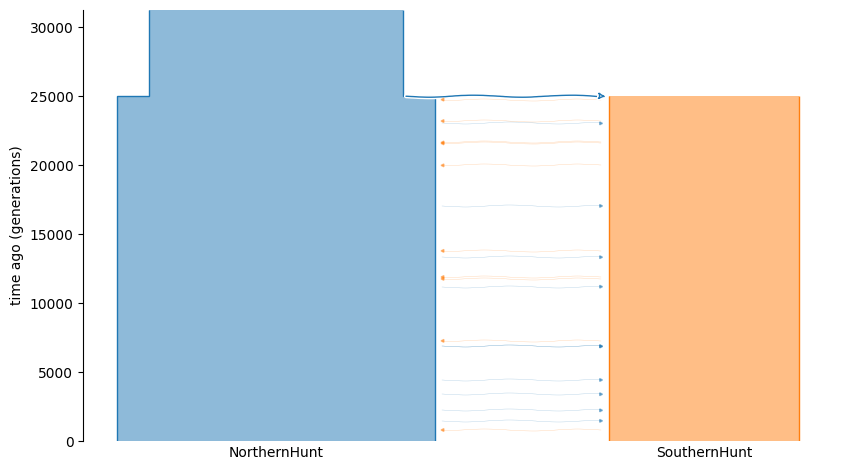
Populations: NorthernHunt, SouthernHunt
Northern and Southern Wild Hunt hosts. Ancestral N=20000. Split 25000 gen ago. North 25000, South 15000. Low migration (5e-6) reflecting seasonal ride routes.
ThreeHuntHosts_3D12
Three population Wild Hunt hosts model
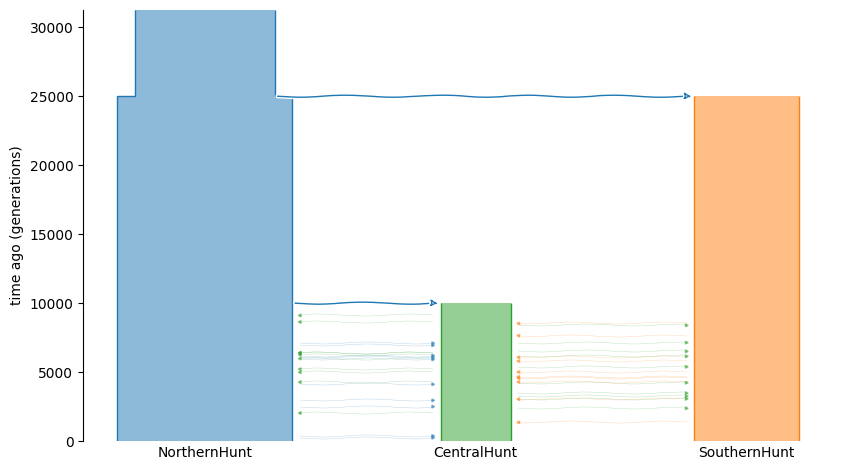
Populations: NorthernHunt, CentralHunt, SouthernHunt
Three Wild Hunt hosts across Germany. Ancestral N=20000. North-South split 25000 gen ago. Central host emerges from North 10000 gen ago. North 25000, Central 10000, South 15000. Stepping-stone migration along ride routes.
ChristianizationBottleneck_1D12
Single population Wild Hunt with Christianization bottleneck
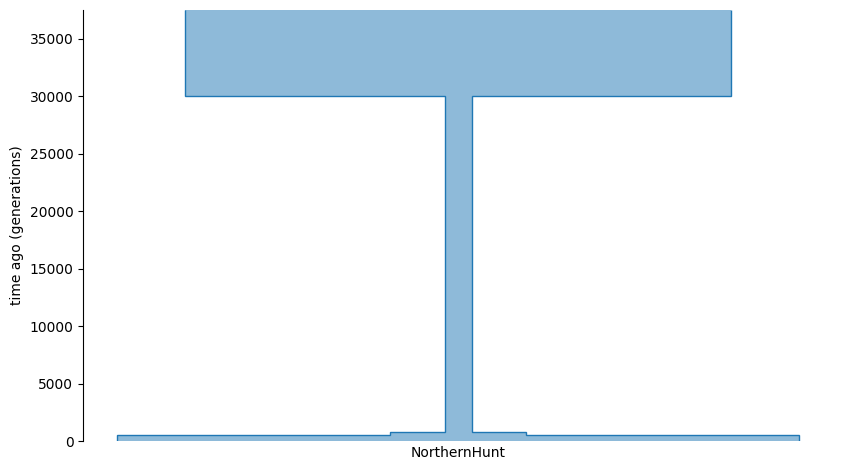
Populations: NorthernHunt
Single Wild Hunt population experiencing a severe bottleneck during Christianization (800 gen ago, N=1000) when pagan beliefs were suppressed. Slow recovery to N=5000 at 500 gen ago. Modern N=25000, ancient stable N=20000 from 30000 gen ago.
NorthSouthHuntIM_2D12
Isolation-with-migration model for Northern and Southern Wild Hunt
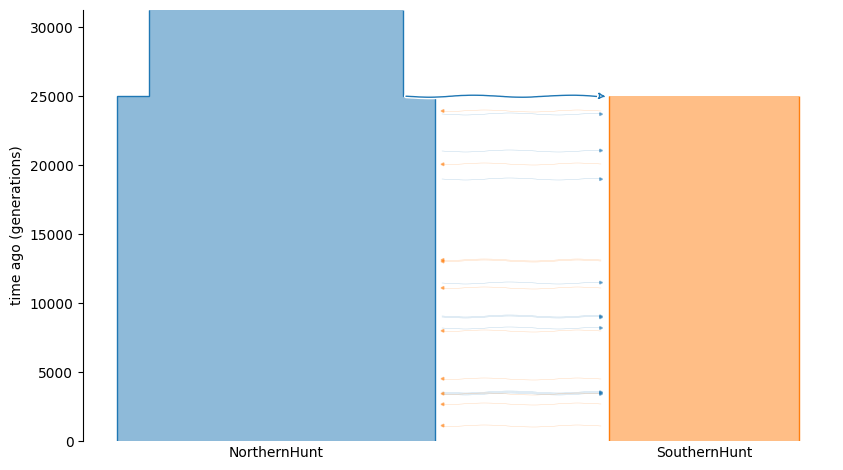
Populations: NorthernHunt, SouthernHunt
Northern and Southern Wild Hunt hosts under an isolation-with- migration framework. Split 25000 gen ago from ancestral N=20000. Asymmetric migration: North->South 8e-6, South->North 3e-6. North 25000, South 15000.
FourHuntRegions_4D12
Four population Wild Hunt model across German regions
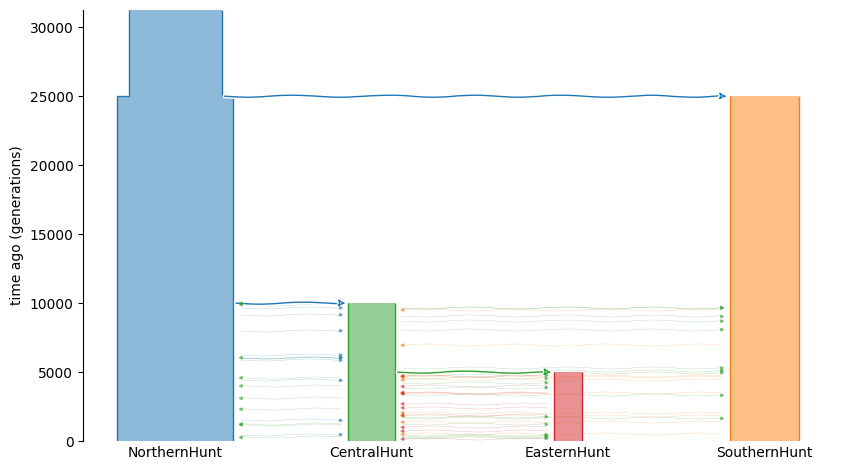
Populations: NorthernHunt, CentralHunt, SouthernHunt, EasternHunt
Four Wild Hunt hosts: Northern, Central, Southern, and Eastern (Silesian/Bohemian borderlands). Ancestral N=20000. South splits 25000 gen ago. Central from North 10000 gen ago. Eastern from Central 5000 gen ago. North 25000, Central 10000, South 15000, East 6000.
WinterSolstice_1D12
Single population Wild Hunt with oscillating population size
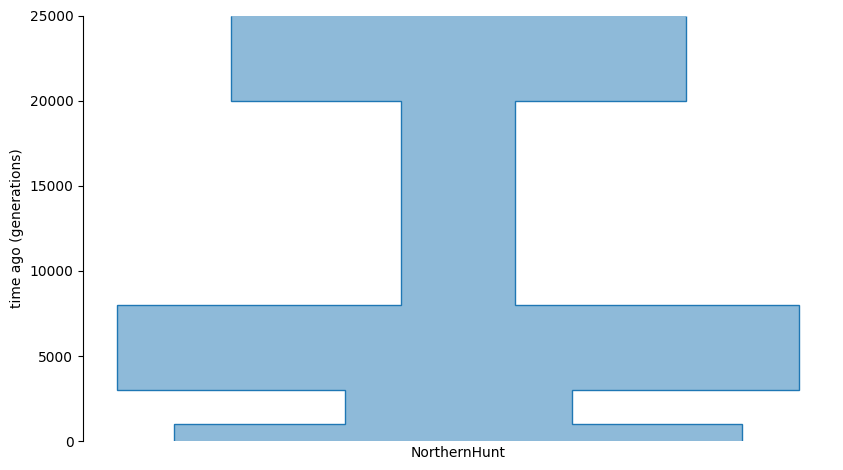
Populations: NorthernHunt
Single Wild Hunt population with oscillating population sizes reflecting seasonal/epochal cycles of belief and power. Modern N=25000, 1000 gen ago N=10000, 3000 gen ago N=30000, 8000 gen ago N=5000, 20000 gen ago N=20000.
Mountain & regional mythology
Rübezahl (Ruebezahl harzensis) — Mountain spirit (Berggeist) of the Riesengebirge (Krkonoše) and Harz.
Genome summary
- ID:
RueHar- Species:
Ruebezahl harzensis
- Common name:
Rübezahl (mountain spirit)
- Assembly:
Ruebezahl1.0(GCA_GRIM_000003)- Ploidy:
2
- Generation time:
100 years
- Population size:
15,000
Chromosomes
Name |
Length (bp) |
Mutation rate |
Recombination rate |
|---|---|---|---|
1 |
28,000,000 |
2.20e-08 |
2.40e-08 |
2 |
25,000,000 |
2.20e-08 |
2.40e-08 |
3 |
22,000,000 |
2.20e-08 |
2.40e-08 |
4 |
20,000,000 |
2.20e-08 |
2.40e-08 |
5 |
18,000,000 |
2.20e-08 |
2.40e-08 |
mountain_mitogenome |
18,000 |
6.00e-08 |
0.00e+00 |
Demographic models
Riesengebirge_1D12
Single population Rübezahl (Riesengebirge) model
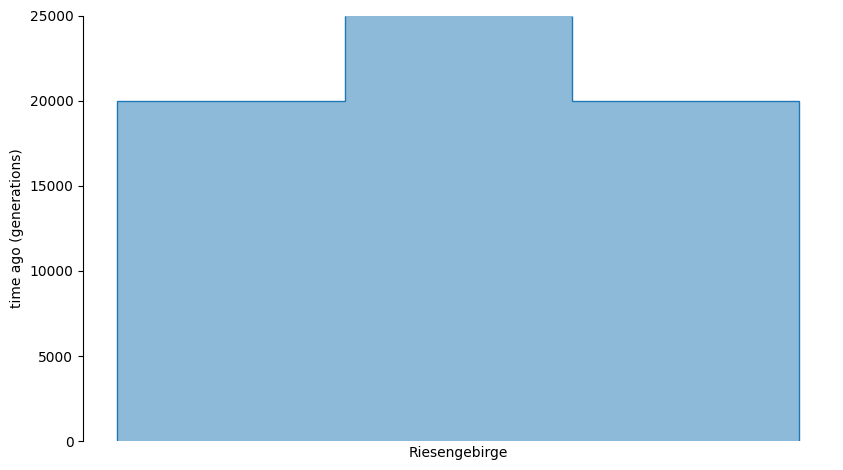
Populations: Riesengebirge
Single population of the mountain spirit in the Riesengebirge (Krkonoše). Modern N=15000, ancient expansion 20000 gen ago (N=5000).
HarzRiesengebirge_2D12
Two population Harz and Riesengebirge model
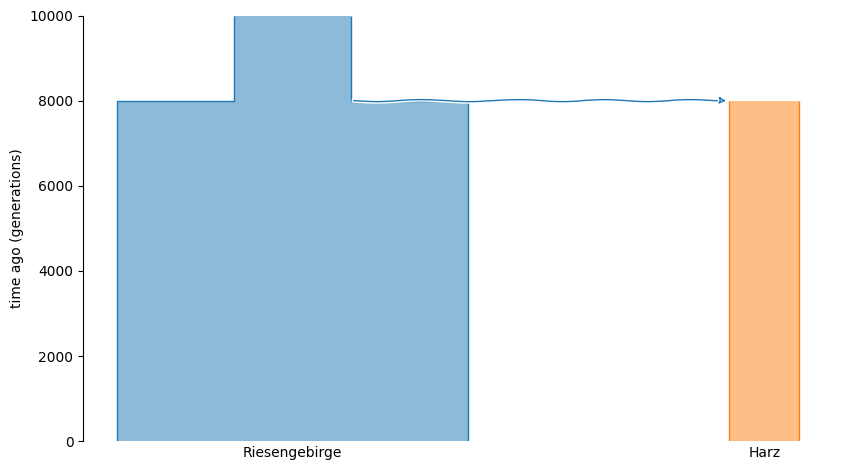
Populations: Riesengebirge, Harz
Riesengebirge core and Harz colony. Ancestral N=5000. Split 8000 gen ago. Riesen 15000, Harz 3000.
ThreeMountains_3D12
Three population mountain spirit model (Riesengebirge, Harz, Erzgebirge)
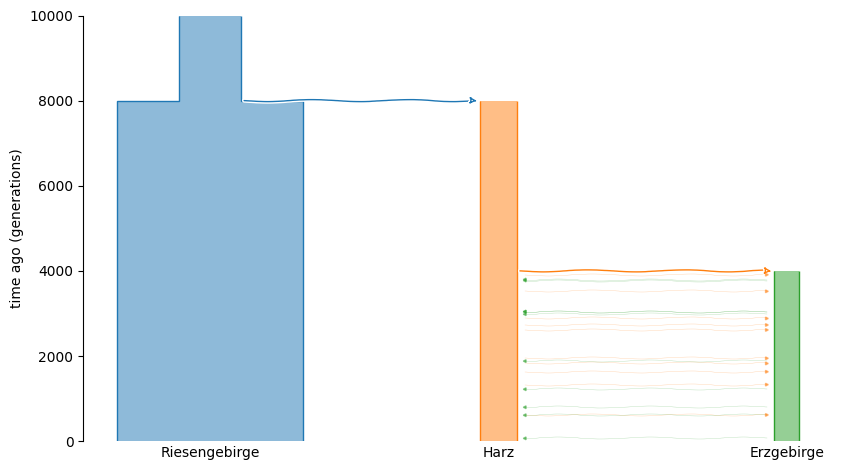
Populations: Riesengebirge, Harz, Erzgebirge
Mountain spirits across three central European ranges. Ancestral N=5000 in Riesengebirge. Harz colony splits 8000 gen ago. Erzgebirge colonized from Harz 4000 gen ago. Riesengebirge grows to 15000, Harz 3000, Erzgebirge 2000. Migration between Harz and Erzgebirge (8e-6 per gen).
AncientMountainSpirit_1D12
Single population ancient mountain spirit with slow exponential growth
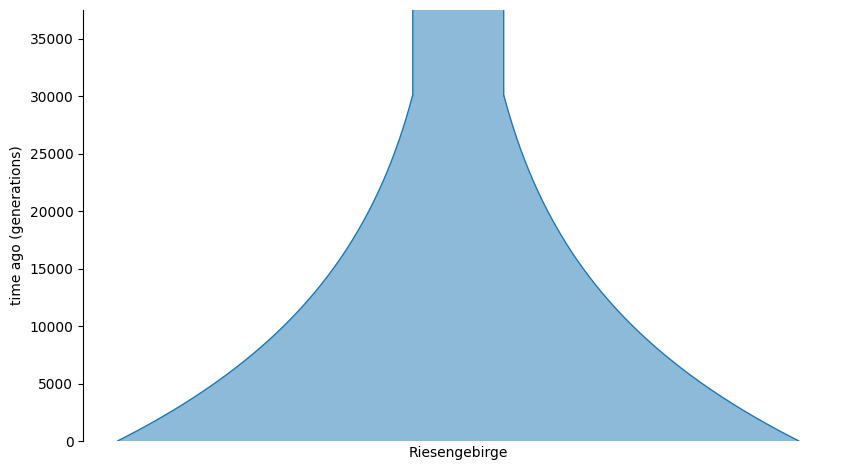
Populations: Riesengebirge
Single population with ancient slow exponential growth. Modern N=15000, growth from N=2000 starting 30000 gen ago. growth_rate = ln(15000/2000)/30000 ~ 0.0000669.
RiesenHarzIM_2D12
Isolation-with-migration model for Riesengebirge and Harz
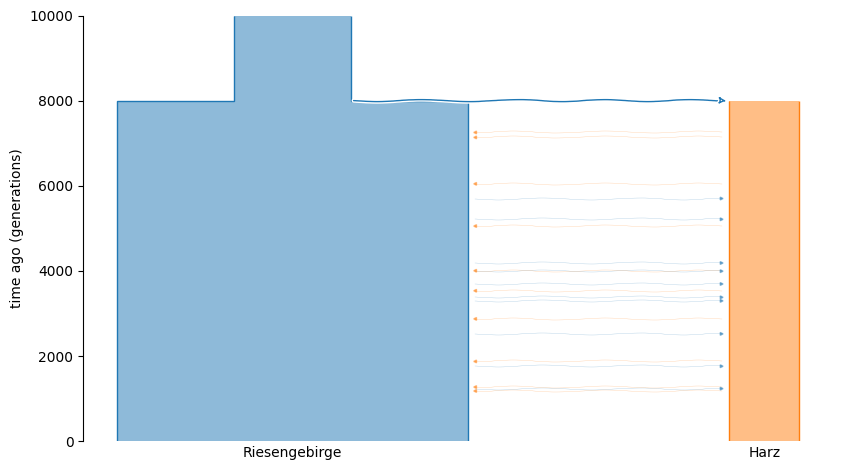
Populations: Riesengebirge, Harz
Isolation-with-migration model. Riesengebirge N=15000, Harz N=3000. Split 8000 gen ago from ancestral N=5000. Migration Riesen->Harz 5e-6, Harz->Riesen 1e-6.
FourMountainSpirits_4D12
Four population mountain spirit model
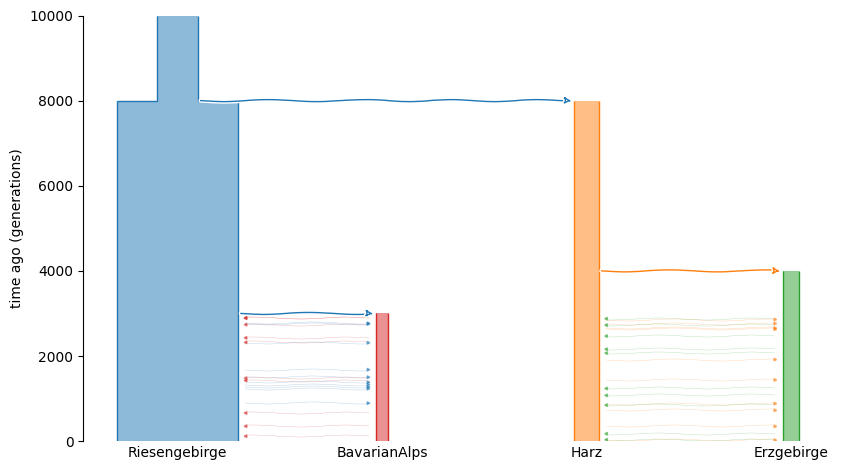
Populations: Riesengebirge, Harz, Erzgebirge, BavarianAlps
Four mountain spirit populations: Riesengebirge, Harz, Erzgebirge, and Bavarian Alps. Ancestral N=5000. Harz splits from Riesengebirge 8000 gen ago. Erzgebirge from Harz 4000 gen ago. Bavarian Alps from Riesengebirge 3000 gen ago. Riesen 15000, Harz 3000, Erzgebirge 2000, Bavarian Alps 1500.
IceAgeSurvival_1D12
Single population ice age survival model
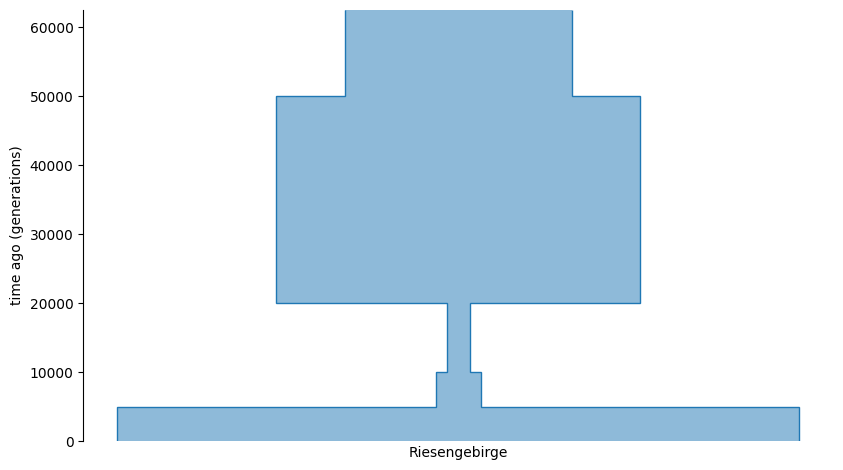
Populations: Riesengebirge
Single population with ice age bottleneck and recovery. Modern N=15000, expansion at 5000 gen ago from N=1000 (post-glacial), ice age bottleneck 10000 gen ago N=500, pre-glacial 20000 gen ago N=8000, ancestral 50000 gen ago N=5000.
Black Forest spirit (Silvani schwarzwaldensis) — Forest spirits of the Schwarzwald.
Genome summary
- ID:
SchWar- Species:
Silvani schwarzwaldensis
- Common name:
Black Forest spirit
- Assembly:
Schwarzwald1.0(GCA_GRIM_000006)- Ploidy:
2
- Generation time:
20 years
- Population size:
120,000
Chromosomes
Name |
Length (bp) |
Mutation rate |
Recombination rate |
|---|---|---|---|
1 |
23,000,000 |
2.50e-08 |
2.50e-08 |
2 |
21,000,000 |
2.50e-08 |
2.50e-08 |
3 |
19,000,000 |
2.50e-08 |
2.50e-08 |
4 |
17,000,000 |
2.50e-08 |
2.50e-08 |
5 |
15,000,000 |
2.50e-08 |
2.50e-08 |
forest_mitogenome |
16,800 |
7.00e-08 |
0.00e+00 |
Demographic models
BlackForest_1D12
Single population Black Forest spirit model
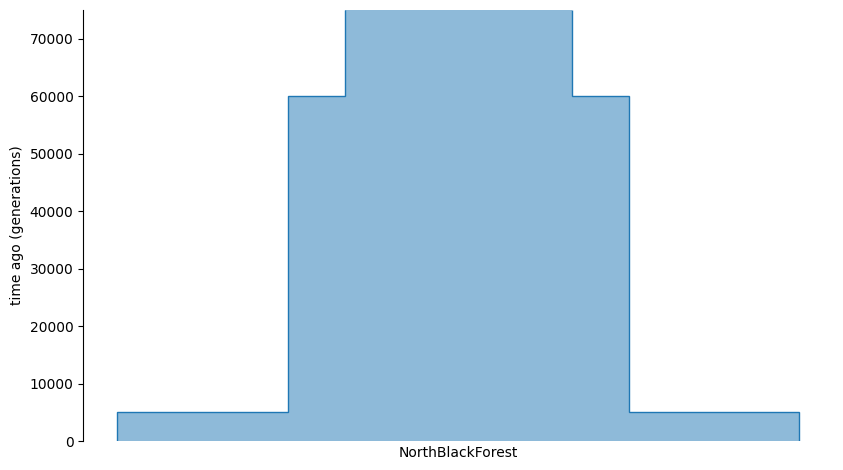
Populations: NorthBlackForest
Single population of forest spirits in the Schwarzwald. Modern N=120000, expansion 5000 gen ago (N=60000), ancestral 60000 gen ago (N=40000).
NorthSouthBlackForest_2D12
Two population North and South Black Forest model
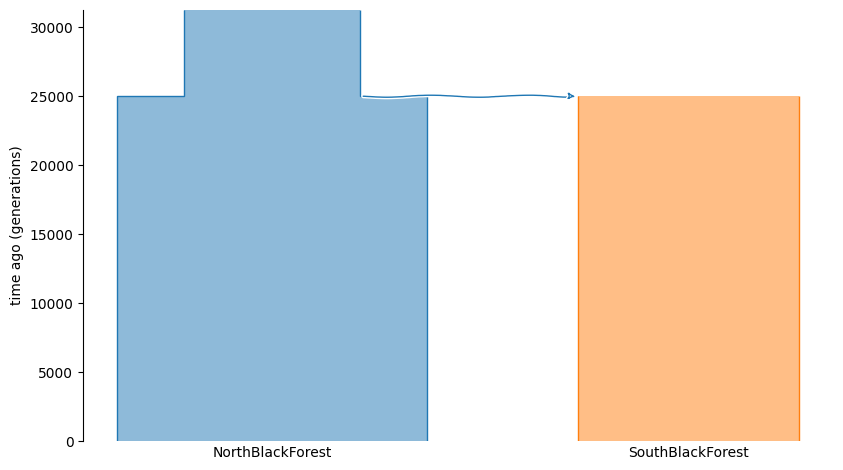
Populations: NorthBlackForest, SouthBlackForest
Northern and Southern Schwarzwald. Ancestral N=40000. Split 25000 gen ago. North 70000, South 50000.
ThreeForestZones_3D12
Three population North, Central, South Black Forest model
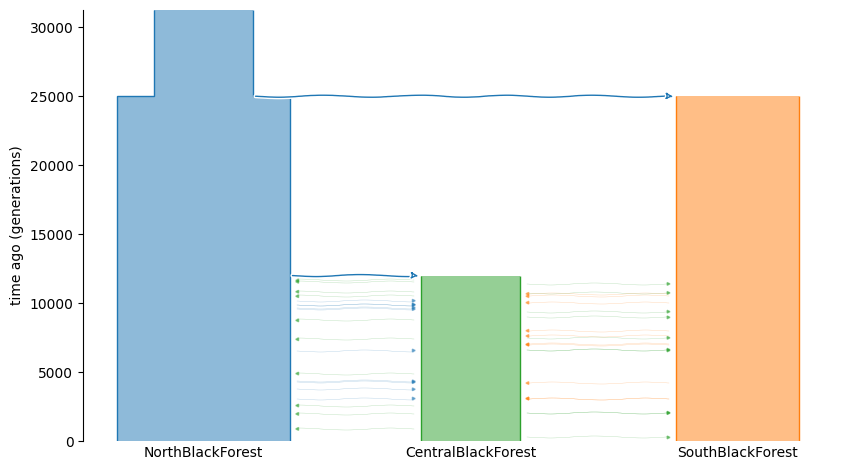
Populations: NorthBlackForest, CentralBlackForest, SouthBlackForest
Three zones of Black Forest spirits. Ancestral N=40000. North-South split 25000 gen ago. Central zone emerges from North 12000 gen ago. North 70000, Central 40000, South 50000. Stepping-stone migration: North-Central 3e-5, Central-South 3e-5.
ForestExpansion_1D12
Single population Black Forest exponential expansion model
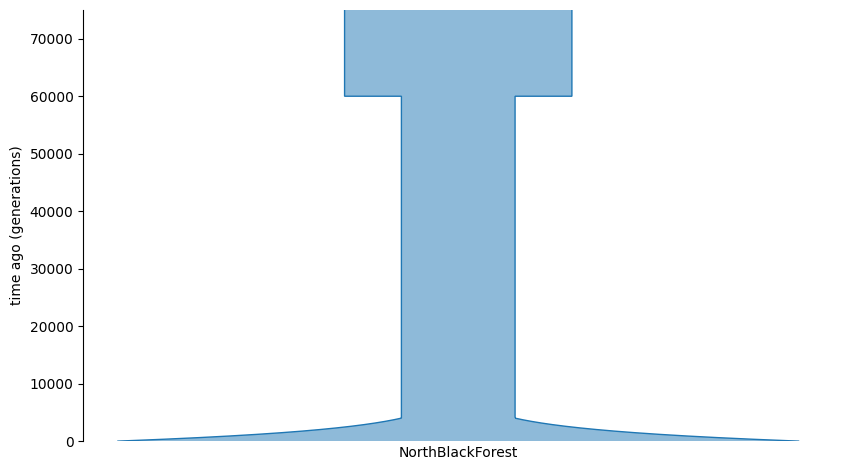
Populations: NorthBlackForest
Single population with exponential growth. Modern N=120000, growth from N=20000 starting 4000 gen ago. Before that stable at 20000 back to 60000 gen ago N=40000. growth_rate = ln(120000/20000)/4000 ~ 0.000448.
NorthSouthIM_2D12
Isolation-with-migration model for North and South Black Forest
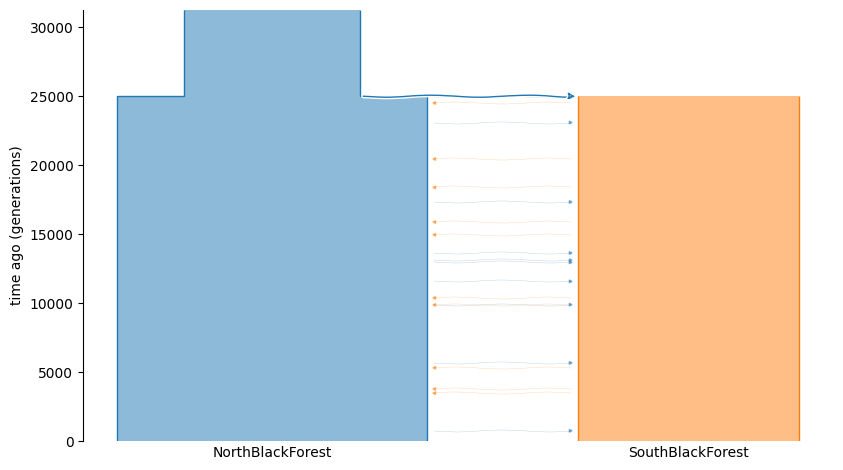
Populations: NorthBlackForest, SouthBlackForest
Isolation-with-migration model. North Black Forest N=70000, South Black Forest N=50000. Split 25000 gen ago from ancestral N=40000. Migration North->South 3e-5, South->North 1e-5.
FourForestValleys_4D12
Four population Black Forest valleys model
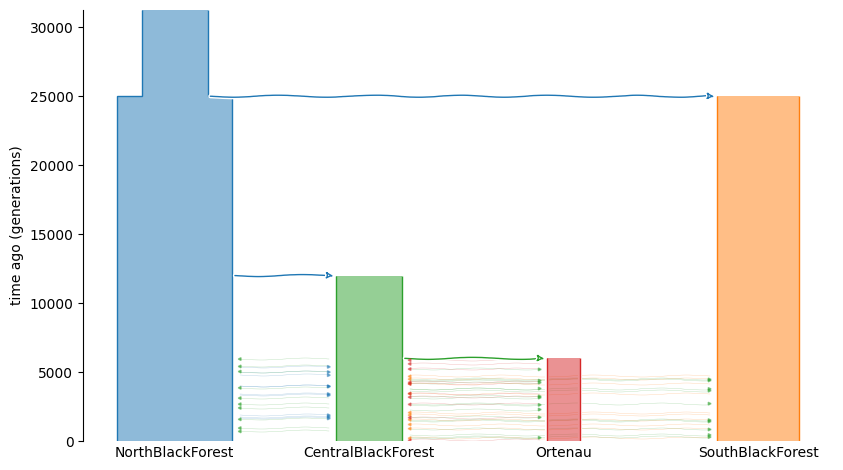
Populations: NorthBlackForest, CentralBlackForest, SouthBlackForest, Ortenau
Four populations: North Black Forest, Central Black Forest, South Black Forest, and Ortenau. Ancestral N=40000. South splits from North 25000 gen ago. Central from North 12000 gen ago. Ortenau from Central 6000 gen ago. North 70000, Central 40000, South 50000, Ortenau 20000. Stepping-stone migration.
DeforestationRecovery_1D12
Single population deforestation bottleneck and recovery model
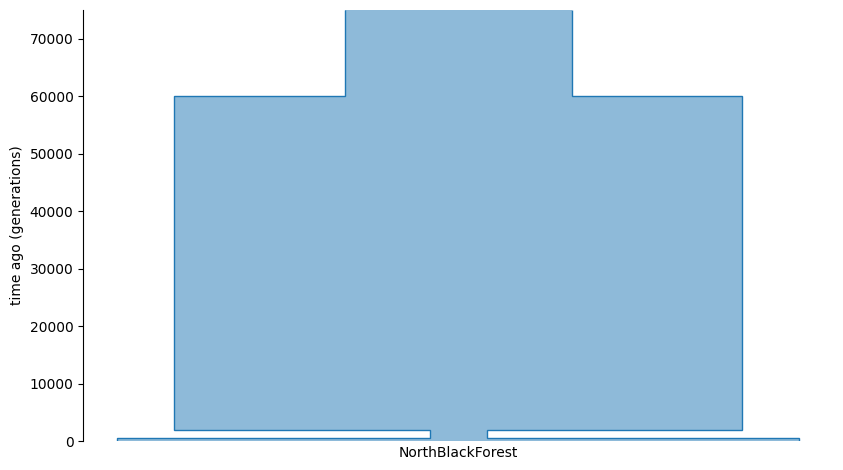
Populations: NorthBlackForest
Single population with deforestation bottleneck. Modern N=120000, bottleneck 500 gen ago N=10000 (deforestation), pre-deforestation 2000 gen ago N=100000, ancestral 60000 gen ago N=40000.
Shape-shifters & mythical beasts
Werwolf (Werwolfus lupinus) — Werewolves from German trial records and folklore, particularly the Rhineland, Bavaria, and Livonian traditions.
Genome summary
- ID:
WerWol- Species:
Werwolfus lupinus
- Common name:
Werwolf (Werewolf)
- Assembly:
Werwolf1.0(GCA_GRIM_000010)- Ploidy:
2
- Generation time:
20 years
- Population size:
10,000
Chromosomes
Name |
Length (bp) |
Mutation rate |
Recombination rate |
|---|---|---|---|
1 |
32,000,000 |
2.30e-08 |
2.40e-08 |
2 |
28,000,000 |
2.30e-08 |
2.40e-08 |
3 |
25,000,000 |
2.30e-08 |
2.40e-08 |
4 |
22,000,000 |
2.30e-08 |
2.40e-08 |
5 |
20,000,000 |
2.30e-08 |
2.40e-08 |
6 |
18,000,000 |
2.30e-08 |
2.40e-08 |
7 |
16,000,000 |
2.30e-08 |
2.40e-08 |
lupine_mitogenome |
16,700 |
7.00e-08 |
0.00e+00 |
Demographic models
Rhineland_1D12
Single population Rhineland Werewolf model
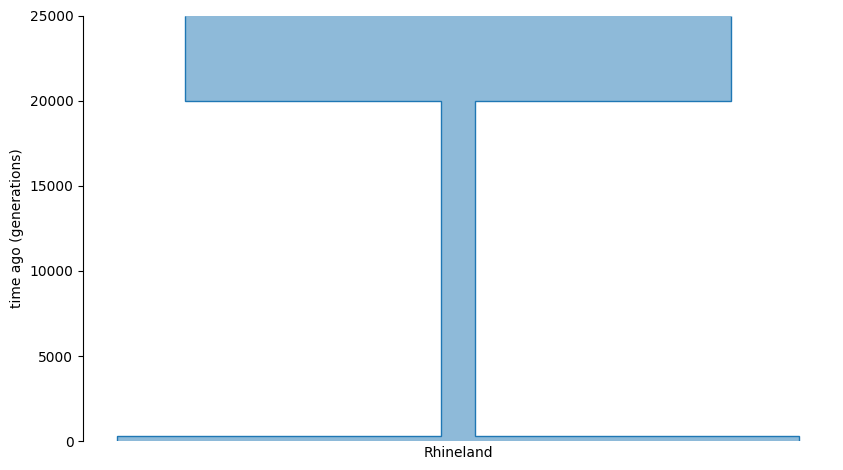
Populations: Rhineland
Single population of Rhineland werewolves (Peter Stumpp region). Modern N=10000, severe bottleneck during witch trials 300 gen ago (N=500), ancestral 20000 gen ago (N=8000).
RhinelandLivonian_2D12
Two population Rhineland-Livonian Werewolf model
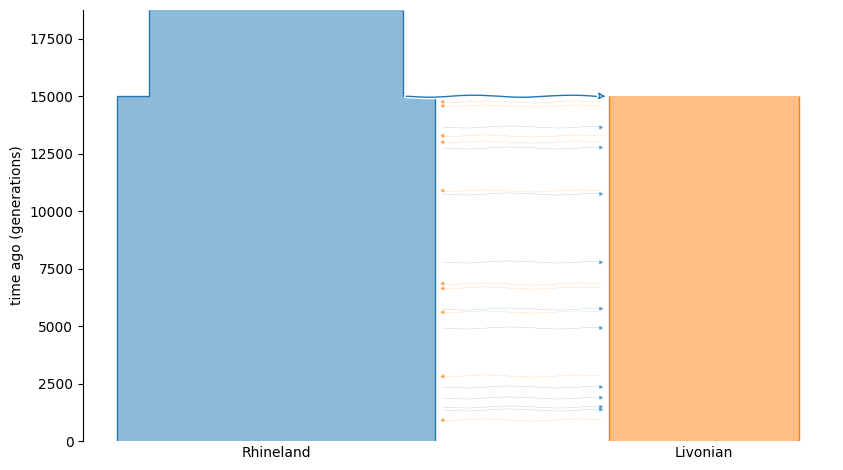
Populations: Rhineland, Livonian
Western (Rhineland) and Eastern (Livonian/Baltic) werewolf populations. Ancestral N=8000. Split 15000 gen ago. Rhineland 10000, Livonian 6000. Very low migration (1e-6).
ThreeWerewolfPacks_3D12
Three population Werewolf model (Rhineland, Bavarian, Livonian)
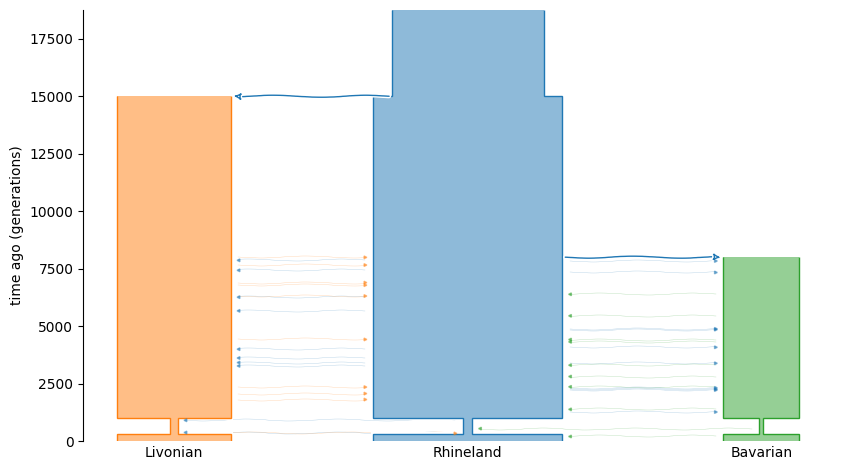
Populations: Rhineland, Bavarian, Livonian
Three werewolf populations across central/eastern Europe. Ancestral N=8000. Livonian splits 15000 gen ago. Bavarian splits from Rhineland 8000 gen ago. Rhineland 10000, Bavarian 4000, Livonian 6000. Both experienced witch-trial bottlenecks 300 gen ago (N=500, 200, 400 respectively).
WitchTrialBottleneck_1D12
Single population Werewolf model with severe witch trial bottleneck
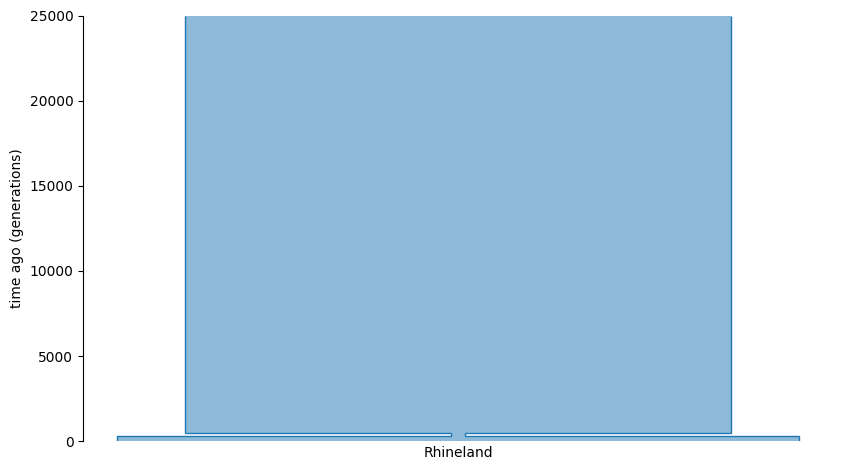
Populations: Rhineland
Single werewolf population with a severe bottleneck during the witch trial era. Modern N=10000, severe bottleneck 300 gen ago (N=200), pre-trial 500 gen ago (N=8000), ancestral 20000 gen ago (N=8000).
RhinelandLivonianIM_2D12
Isolation-with-migration model for Rhineland and Livonian werewolves
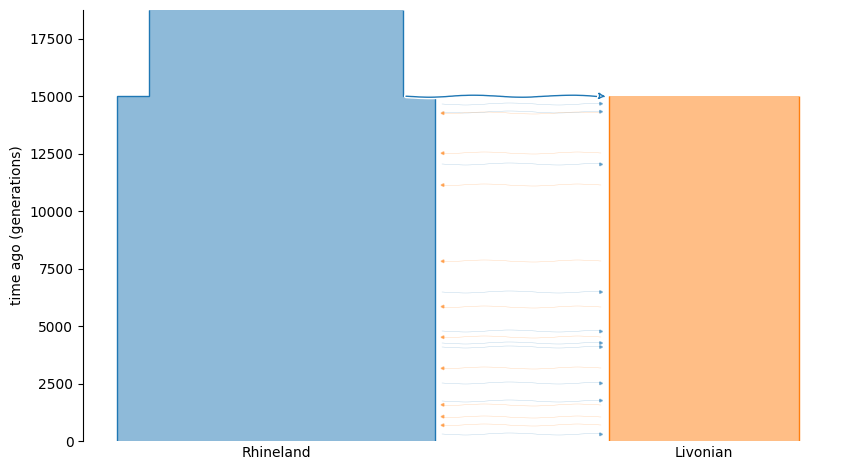
Populations: Rhineland, Livonian
Isolation-with-migration (IM) model for Rhineland and Livonian werewolf populations. Rhineland 10000, Livonian 6000. Split 15000 gen ago from ancestral N=8000. Asymmetric migration: Rhineland->Livonian 2e-6, Livonian->Rhineland 1e-6.
FourWerewolfPacks_4D12
Four population Werewolf model (Rhineland, Bavarian, Livonian, Franconian)
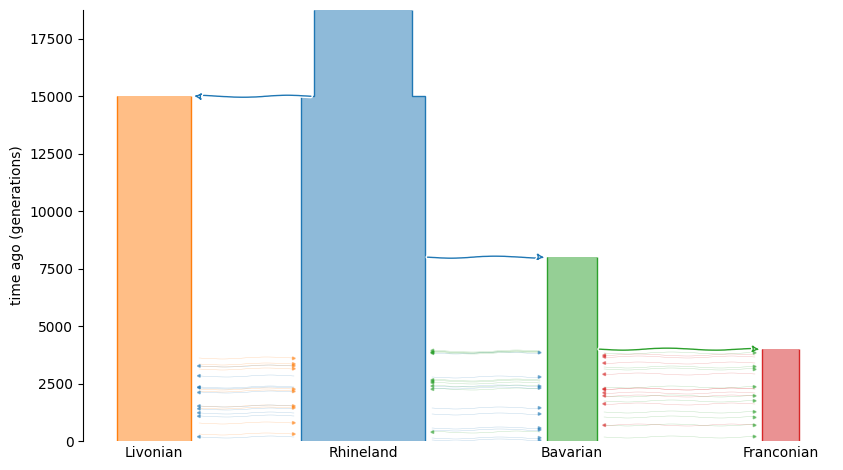
Populations: Rhineland, Bavarian, Livonian, Franconian
Four werewolf populations across central/eastern Europe. Ancestral N=8000. Livonian splits 15000 gen ago. Bavarian splits from Rhineland 8000 gen ago. Franconian splits from Bavarian 4000 gen ago. Rhineland 10000, Bavarian 4000, Livonian 6000, Franconian 3000. Low migration.
LycanthropeRecovery_1D12
Single population Werewolf model with near-extinction and recovery
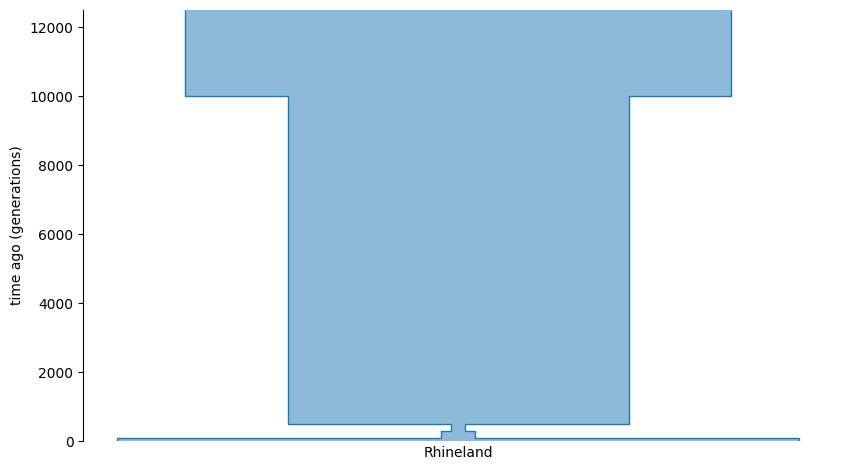
Populations: Rhineland
Single werewolf population showing recovery from near-extinction. Modern N=10000, recent rapid recovery: 100 gen ago N=500, nadir 300 gen ago N=200, pre-decline 500 gen ago N=5000, ancient stable 10000 gen ago N=8000.
Lindwurm (Lindwurm draconicus) — The wingless dragon of Germanic legend (Nibelungenlied’s Fafnir, Klagenfurt Lindwurm), with long generation times and small populations driven near extinction by hero-slaying.
Genome summary
- ID:
LinDra- Species:
Lindwurm draconicus
- Common name:
Lindwurm (Dragon)
- Assembly:
Lindwurm1.0(GCA_GRIM_000012)- Ploidy:
2
- Generation time:
200 years
- Population size:
2,000
Chromosomes
Name |
Length (bp) |
Mutation rate |
Recombination rate |
|---|---|---|---|
1 |
40,000,000 |
1.80e-08 |
2.00e-08 |
2 |
35,000,000 |
1.80e-08 |
2.00e-08 |
3 |
30,000,000 |
1.80e-08 |
2.00e-08 |
4 |
27,000,000 |
1.80e-08 |
2.00e-08 |
5 |
24,000,000 |
1.80e-08 |
2.00e-08 |
6 |
21,000,000 |
1.80e-08 |
2.00e-08 |
7 |
18,000,000 |
1.80e-08 |
2.00e-08 |
8 |
15,000,000 |
1.80e-08 |
2.00e-08 |
draconic_mitogenome |
20,000 |
5.00e-08 |
0.00e+00 |
Demographic models
RhineDragon_1D12
Single population Rhine dragon model
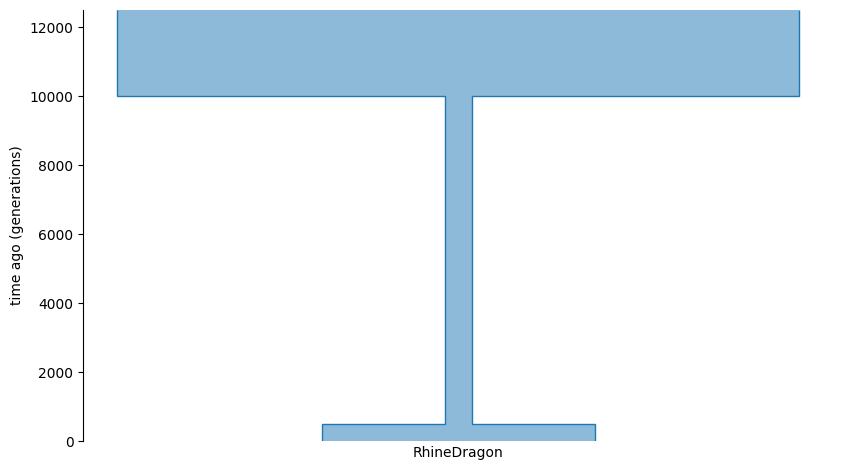
Populations: RhineDragon
Single population of Rhine valley dragons (Nibelungen tradition). Modern N=2000, severe decline 500 gen ago (N=200) due to hero-slaying, ancestral 10000 gen ago (N=5000).
RhineKlagenfurt_2D12
Two population Rhine-Klagenfurt Lindwurm model
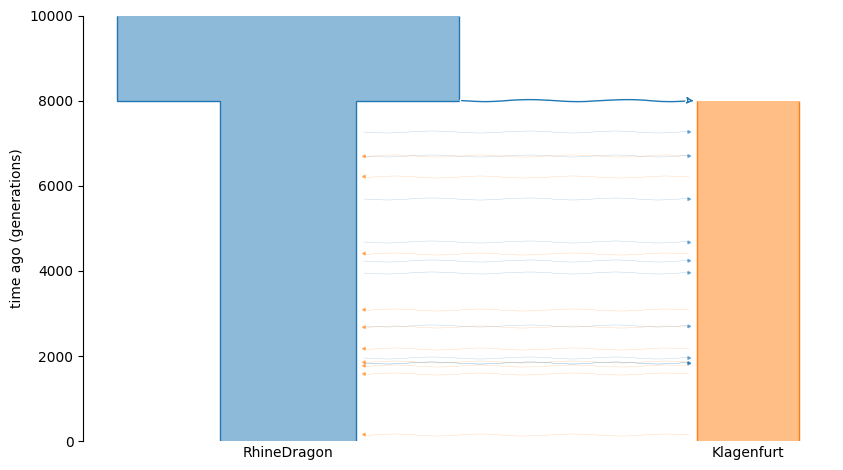
Populations: RhineDragon, Klagenfurt
Rhine and Klagenfurt dragon populations. Ancestral N=5000. Split 8000 gen ago across the Alps. Rhine 2000, Klagenfurt 1500. Very low migration (5e-7) across mountain barriers.
ThreeDragonLairs_3D12
Three population Lindwurm model (Rhine, Klagenfurt, Scandinavian)
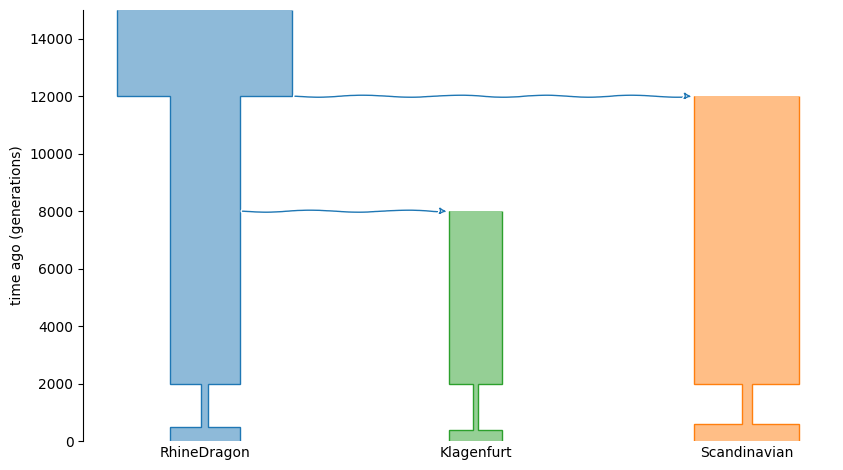
Populations: RhineDragon, Klagenfurt, Scandinavian
Three dragon populations. Ancestral N=5000. Scandinavian splits 12000 gen ago. Klagenfurt splits from Rhine 8000 gen ago. Rhine 2000, Klagenfurt 1500, Scandinavian 3000. All experienced hero-slaying bottlenecks at different times.
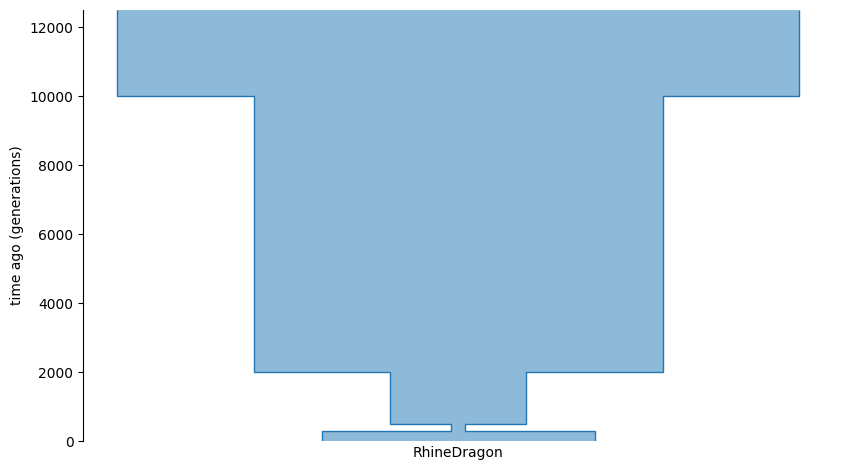
DragonSlayerBottleneck_1D12
Single population dragon model with multiple hero-slaying bottlenecks
Populations: RhineDragon
Single dragon population with multiple bottlenecks caused by hero-slaying events. Modern N=2000, 300 gen ago N=100 (Siegfried era), 500 gen ago N=1000, 2000 gen ago N=3000, ancestral 10000 gen ago N=5000.
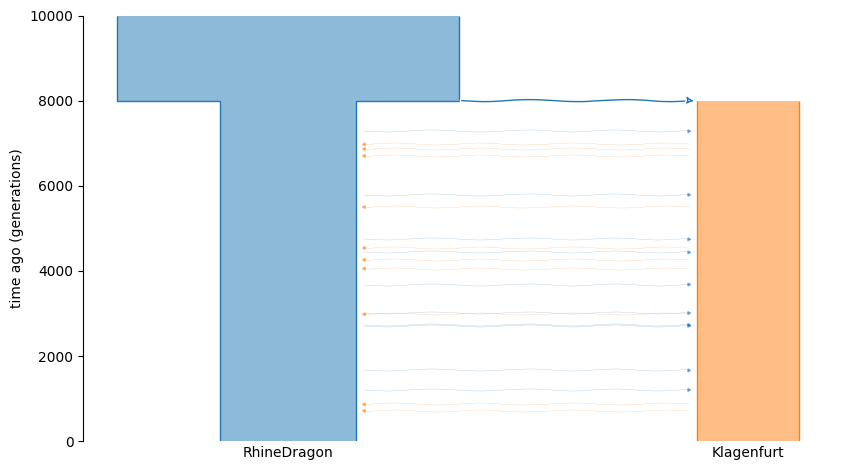
RhineKlagenfurtIM_2D12
Isolation-with-migration model for Rhine and Klagenfurt dragons
Populations: RhineDragon, Klagenfurt
Isolation-with-migration (IM) model for Rhine and Klagenfurt dragon populations. RhineDragon 2000, Klagenfurt 1500. Split 8000 gen ago from ancestral N=5000. Asymmetric migration: Rhine->Klagenfurt 1e-6, Klagenfurt->Rhine 5e-7.
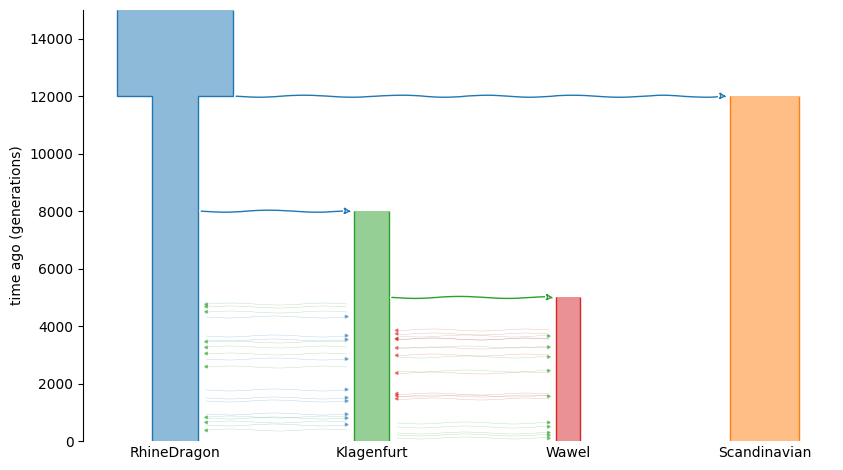
FourDragonLairs_4D12
Four population Lindwurm model (Rhine, Klagenfurt, Scandinavian, Wawel)
Populations: RhineDragon, Klagenfurt, Scandinavian, Wawel
Four dragon populations. Ancestral N=5000. Scandinavian splits 12000 gen ago. Klagenfurt splits from Rhine 8000 gen ago. Wawel splits from Klagenfurt 5000 gen ago. Rhine 2000, Klagenfurt 1500, Scandinavian 3000, Wawel 1000.
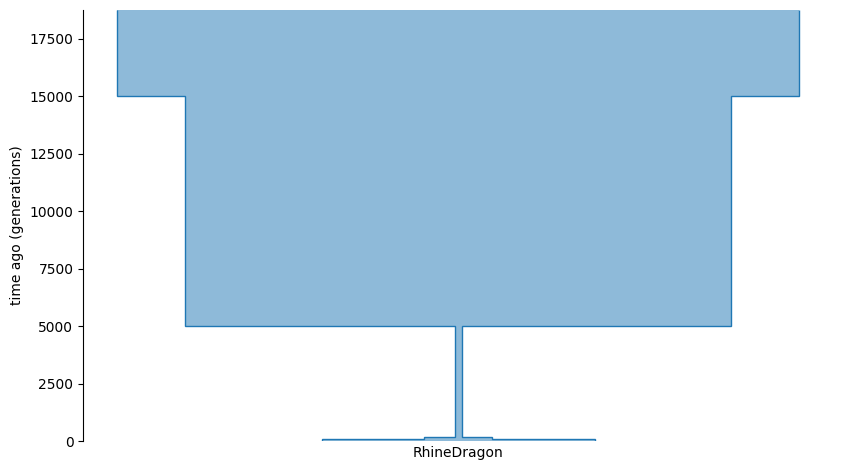
NearExtinction_1D12
Single population dragon model with near-extinction event
Populations: RhineDragon
Single dragon population with near-extinction and partial recovery. Modern N=2000, recovery 100 gen ago N=500, near extinction 200 gen ago N=50, ancient population 5000 gen ago N=4000, ancestral 15000 gen ago N=5000.
Generic models
In addition to the species-specific models listed in this catalog, stdgrimmsim offers
generic demographic models that can be run with any species.
These are described in the API.